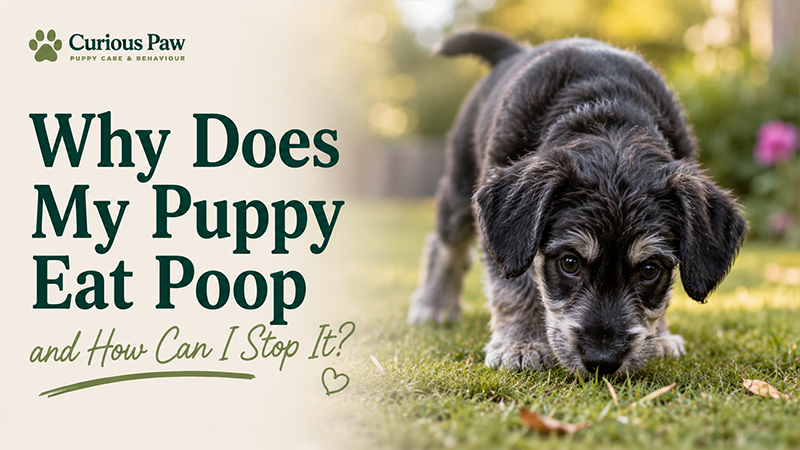
It’s called coprophagia, and roughly one in six dogs does it at some point. More common in puppies than adult dogs, more common in multi-dog households, and far more common than most owners realize until they catch their puppy doing it and feel uniquely horrified. They aren’t. This happens all the time. The more useful question is why it’s happening in this specific dog, because the cause changes what you do about it.
Why Puppies Do This
Before their puppies are weaned, mother dogs routinely eat their offspring’s feces to keep the den clean and to avoid attracting predators. It’s an evolved sanitation behavior, and puppies sometimes observe it and imitate it. In the wild, canines are also opportunistic scavengers, and feces from other animals frequently contains undigested nutrients. A puppy investigating poop isn’t doing something wrong by their own instincts. It just doesn’t translate well to living in your house.
Many puppies try it once or twice out of pure investigation and then lose interest entirely. If the puppy is very young and this is occasional behavior, removing access quickly — picking up immediately after they go — is often all that’s needed. The behavior stops when the opportunity disappears.
The Punishment Trap
This deserves its own section because it’s one of the most common ways owners make the problem significantly worse while trying to fix it. A puppy that gets punished for having indoor accidents sometimes starts eating the feces to eliminate the evidence. The owner then finds no accident, concludes the training is working, and doesn’t connect the dots until they actually catch the puppy in the act. At that point, they punish the eating, which the puppy now connects to getting caught rather than to the behavior itself — and learns to be faster and more discreet. According to the AKC, punishment-based potty training consistently produces or worsens coprophagia. The puppy isn’t being clever or defiant. They’re scared, and eating the evidence is the only way they know to avoid an unpredictable response.


Switching to positive reinforcement only — reward outdoor successes, clean up indoor accidents without comment — is the first intervention if this sounds like your situation. The behavior often resolves quickly once the fear driver is removed.
Attention and Boredom
A puppy learns quickly that eating or picking up feces produces a dramatic reaction — running over, animated shouting, reaching into their mouth. That’s a significant amount of focused human attention. Some puppies learn to manufacture that situation deliberately, particularly if the only time they get that level of engagement is when they do something disgusting. The fix is the opposite of the natural response: take the poop away calmly, redirect to something else without making a production of it, and make sure the puppy is getting adequate engagement and stimulation through other means. An under-stimulated puppy invents entertainment.
When the Cause Is Medical
Intestinal parasites leach nutrients and can drive a puppy to seek them from unusual sources. Malabsorption conditions — where food passes through without being fully digested — produce nutrient-rich stool that smells and tastes like food to a dog. Exocrine pancreatic insufficiency, though uncommon, does exactly this. If the puppy is also showing other signs — unusually soft or frequent stool, weight loss despite eating normally, a visibly distended belly — a vet check including fecal testing is appropriate before treating this as purely behavioral.
Sudden onset of the behavior in an adult dog that’s never done it before, especially alongside weight changes or digestive symptoms, is worth a vet call regardless of other explanations.
What Actually Stops It
Remove access to poop immediately and consistently. A puppy cannot eat feces that isn’t there. Picking up immediately after they eliminate — before they have any opportunity to investigate — is the single most effective intervention, and it works independently of any training approach. Combined with calm redirection and adequate stimulation, it resolves the behavior in most puppies without needing further intervention.
A solid “leave it” cue, trained in low-distraction settings first and practiced until genuinely reliable, gives you a tool for the moments when removal in advance wasn’t possible. It needs to be worth more than the thing they’re being asked to leave — so high-value treats, not kibble, at least during the training phase.
Stool deterrent additives — products designed to make poop taste bad, or pineapple added to food — produce inconsistent results in practice. Some owners swear by them. Controlled research doesn’t support them reliably. They’re worth trying if nothing else is working, but not worth leading with when more reliable interventions exist.
One situation worth specific mention: cats. Cat feces is particularly attractive to dogs because the protein content in cat food makes it smell and taste interesting to a dog nose. A puppy with access to a litter box will find it reliably and return to it. A baby gate that allows the cat access but blocks the dog, a covered box in a room with a cat door the puppy can’t fit through, or a high-sided box on an elevated surface all solve this cleanly. No amount of training competes well with an accessible litter box for a motivated puppy.
Frequently Asked Questions
Will my puppy just grow out of eating poop?
Many do, especially if the behavior is curiosity-driven and access is managed consistently. Most vets note that puppies who only do it occasionally tend to lose interest by 6 months. The ones who don’t outgrow it are typically the ones where the behavior was reinforced — through dramatic owner reactions, through punishment that created fear, or through consistent access to feces that allowed the habit to cement. Removing access and responding calmly gives the behavior the best chance of resolving on its own.
Does pineapple actually stop dogs from eating poop?
Results are mixed and not reliably supported by research. The idea is that pineapple (and similar commercial additives) makes the stool taste unpleasant enough to deter the dog — but the same dog that finds their own poop interesting will often eat it anyway. It’s worth trying if access management and redirection aren’t resolving things, but it works for some dogs and not others and isn’t a replacement for addressing the underlying cause.
My puppy only eats poop when I’m not looking — does that mean they know it’s wrong?
Not exactly. Puppies that eat poop when the owner isn’t watching have usually learned that the behavior produces a response when the owner is present — so they’ve associated the behavior with owner presence, not with wrongness. It often develops when punishment has been used, teaching the puppy that getting caught, not the behavior itself, is what triggers the reaction. Removing the punishment element and cleaning up quickly regardless of whether you see it happen usually changes this pattern.
The puppies still doing this at 12 months are almost always the ones where the behavior was accidentally reinforced early — either through dramatic reactions, through punishment that created fear around elimination, or through access that was never managed consistently. The window to break the habit cleanly is early.
- American Kennel Club — Why Do Dogs Eat Poop and How to Stop It
- PetMD — Why Do Dogs Eat Poop?
- PetMD — Why Do Puppies Eat Poop?