
The mistake that causes most problems doesn’t happen during the introduction itself. It happens in the 60 seconds before it, when a child runs across the room toward the puppy, reaches down quickly from above, and tries to pick them up before the puppy has had any time to understand what’s happening. To the puppy, that sequence reads as a threat. The child’s excitement and goodwill are entirely irrelevant to a nervous system that’s processing speed, overhead approach, and sudden confinement as potential danger signals.
Successful introductions require preparation on both sides — and the preparation for the child matters more than anything you do with the puppy on the day.
Brief the Children First
Children need specific, concrete instructions — not general ones. “Be gentle” means different things to a four-year-old and a ten-year-old, and neither of those things is what you actually need. What helps: no running toward the puppy, no sudden movements, no reaching down from above, no picking up without an adult actively helping, no touching while the puppy is eating or sleeping, and no hugging around the neck or face. Most puppies find the classic child-hug uncomfortable even when they tolerate it, and tolerance isn’t the goal.
The single most important instruction — and the hardest for young children to follow — is this: if the puppy moves away, let it go. A puppy that retreats from an interaction is communicating something real. Teaching children to read that signal and respect it, rather than pursuing the puppy, is the foundation of a safe relationship. A puppy that can always retreat when overwhelmed has no reason to escalate to harder signals like growling or snapping.
The First Meeting
Do it in a calm space, at a calm moment. Not when children have just arrived home buzzing from school, not when guests are also arriving and the environment is already stimulating. A quiet room, everyone settled, the puppy given a moment to sniff and orient before anyone moves toward them.


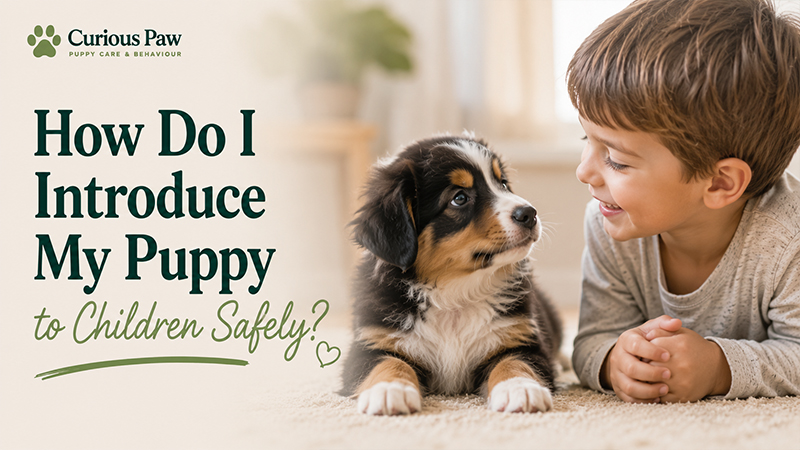
Have the children sit on the floor rather than standing. This is less imposing to the puppy and makes it easier for the puppy to approach rather than the child reaching down. Let the puppy decide whether to come over. If it does — gentle, slow strokes along the back. Not the face, not the top of the head with quick pats, not the tail. If the puppy doesn’t come over immediately, that’s fine. Don’t push proximity on the first meeting.
Treats help enormously here. Having the child hold a treat flat on an open palm and letting the puppy eat from their hand creates a positive association between the child’s presence and something good. It also gives the child something to do correctly rather than just existing near the puppy and trying to control their impulses. A child with a job is easier to manage than a child who’s just been told not to do things.
Reading What the Puppy Is Telling You
A relaxed puppy has a loose, wiggly body, soft eyes, and moves toward rather than away from the people in the room. A stressed puppy shows earlier, subtler signals that most people miss: stiffening body, whale eye (the white visible at the corner of the eye), yawning, lip licking, turning away, or suddenly becoming very interested in sniffing the floor. These aren’t meaningless fidgets. They’re the puppy communicating that something about the interaction is too much.
If you see those signals during an introduction, end the session calmly — “let’s give the puppy a break” without drama or apology. The puppy needs to learn that it can communicate discomfort and the adults in the room will respond. That safety net is what prevents escalation to the signals nobody misses.
Different Ages, Different Approaches
Toddlers and very young children are the highest-risk group in puppy interactions — not because of bad intentions, but because their movements are genuinely unpredictable, their faces are at puppy-face height, they don’t read body language, and they can’t reliably follow instructions. Every single interaction between a toddler and a puppy requires direct adult supervision. Not across-the-room supervision. In the room, watching, ready to intervene. The AKC recommends never leaving a dog and a child under 10 unsupervised regardless of how established the relationship is, and that guidance applies especially to very young children with a new puppy.
Children from around 6 upward can be taught specific handling rules and are generally capable of following them with reminders and consistency. They can also participate in short, positive training sessions with the puppy — asking for a sit before giving a treat, practicing a recall, working on basic commands together — which builds relationship faster than passive interaction alone. A child who learns to ask the puppy to sit before petting has changed the entire dynamic: the puppy is now paying attention to the child, and the child has a skill rather than just instructions about what not to do.
The Safe Space Rule
Every puppy needs a place — crate, gated area, specific room — that children understand is completely off-limits. Not “we don’t bother the puppy there unless it’s really important,” but genuinely, absolutely off-limits. A puppy that has no retreat will eventually find one itself, and the retreat it chooses may not be workable. A puppy that always has access to a space where it won’t be followed can decompress without having to escalate to warn people away.
Enforce this rule from day one and hold it consistently. “The puppy’s crate is the puppy’s space — we don’t reach in there” is one of the simplest rules to establish early and one of the most protective of both the puppy and the children over the long term.
If Something Goes Wrong
A puppy that snaps at a child is almost always communicating that earlier signals were missed — a retreat that wasn’t allowed, handling that was too intense, stress signs that went unread. It isn’t a sign the puppy is dangerous or unsuitable for family life. It’s information. The correct response is to review what led up to it and adjust the interaction structure — not to punish the puppy for communicating, which removes the warning signal without addressing the underlying cause.
A bite that breaks skin in a young puppy during normal interaction is worth a vet check to rule out pain or a specific trigger, and a conversation with a positive-reinforcement trainer about structure going forward. Most puppy-child bite incidents happen because supervision lapsed, boundaries weren’t enforced, or early signals were ignored — not because the puppy is inherently problematic.
A puppy raised with children who learned to read its signals and respect its space tends to become a dog that’s genuinely comfortable with kids, not just tolerant of them. Those are different outcomes, and the one that’s actually pleasant to live with is built in these early months.
Frequently Asked Questions
My puppy keeps nipping at my kids — is that normal?
Very normal, and more likely with children than adults because children move faster, squeal at higher pitches, and run — all of which trigger the play-chase instinct in a puppy. Teaching children to stop moving and cross their arms the moment nipping starts removes the reward of the behavior more effectively than yelling does. Consistent short sessions with treats for calm interaction, and ending play the moment teeth touch skin, typically resolves most puppy nipping with children within a few weeks.
How do I know if my puppy is just playing or actually scared of my child?
Playing looks loose and bouncy — the puppy initiates, retreats, comes back, wags broadly. Fear looks stiff — body tense, moving away rather than toward, whale eye showing, yawning or lip licking when the child approaches. A puppy that consistently tries to leave interactions with a specific child, hides when that child enters the room, or freezes when handled isn’t playing. That pattern warrants a slower reintroduction and more controlled interactions rather than more of the same.
At what age can kids be around the puppy without constant supervision?
The AKC recommends supervising all interactions between children under 10 and dogs. For older children, it depends on the individual child’s ability to read the dog’s body language and respond appropriately — not just follow rules when reminded. Most families find that by the time the dog is 12 to 18 months and the relationship is well-established, direct supervision can relax, but proximity awareness — being in earshot and checking in — remains useful indefinitely.
- American Kennel Club — Puppy Socialization: Why, When, and How to Do It Right
- American Veterinary Medical Association — Socialization of Dogs and Cats