
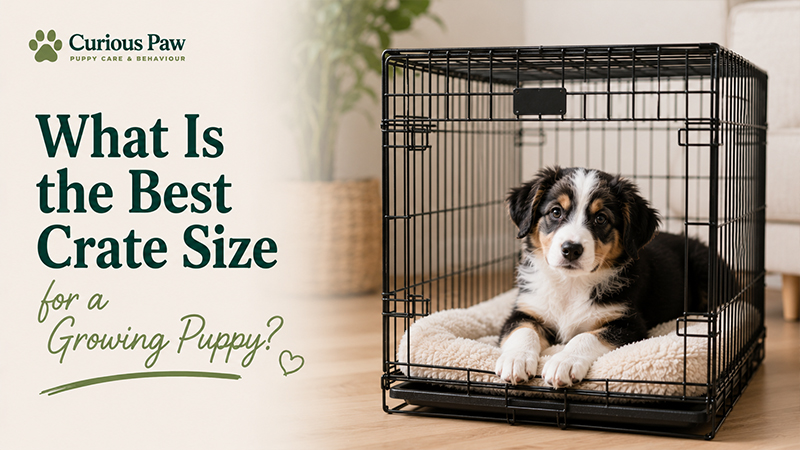
Buy the crate your puppy will need as an adult, not the one that fits them right now. That’s the counterintuitive starting point, and it’s the advice most first-time owners receive too late — after they’ve already bought a small crate, watched the puppy outgrow it in eight weeks, and are now buying a second one anyway. One crate, sized for adulthood, with a divider panel, works from 8 weeks to the dog’s full adult life. The divider is what makes this possible.
Why Size Affects Housetraining
Dogs naturally avoid soiling where they sleep. This instinct is what makes crate training effective for housetraining — a correctly sized crate leaves the puppy no comfortable alternative to holding it. The crate should be just large enough for the puppy to stand up, turn around, and lie down fully stretched. Nothing more.
Give a puppy too much space and the mechanism breaks down. A puppy with a crate large enough to walk around in will use one end as a sleeping area and the other end as a bathroom and go back to sleep entirely unfazed. The housetraining benefit disappears, and owners often conclude the crate training isn’t working when the actual problem is just excess space. A divider panel solves this by letting you set the usable depth at the right size for the current puppy and adjust it forward as they grow.
How to Size It Correctly
According to the AKC, measure the dog from the tip of the nose to the base of the tail for length, and from the floor to the top of the head when standing for height. Add 3 to 4 inches to each measurement. That gives you the minimum interior dimensions the crate needs at adult size.


For a puppy you haven’t measured yet — which is most people’s situation — use the breed standard as a reference. Most breed registries publish typical adult height and weight ranges by sex, and those figures are reliable enough to size a crate from before the puppy arrives. If you have a mixed breed and genuinely don’t know the parentage, your vet can give a growth estimate at the first appointment. When measurements fall between standard crate sizes, go larger. A slightly larger crate adjusted with a divider is fine. A too-small crate that can’t be stretched isn’t.
Using the Divider Panel
Most wire crates come with a divider panel included. It slots into adjustable tracks inside the crate, letting you set the usable depth at whatever length is appropriate for the puppy’s current size. The starting position should give the puppy just enough room to stand, turn, and lie stretched out — not a foot of extra space, just the right amount. As the puppy grows, you move the panel back in stages. The timing isn’t fixed — watch the puppy, and when they’re sleeping fully stretched and their feet consistently reach close to the panel, move it back a few inches. Then watch again.
The mistake most owners make here is moving the divider in large jumps — from “puppy-sized” to “halfway” to “full” in two or three adjustments over several months. Moving it in smaller increments, every few weeks during rapid growth phases, keeps the space consistently appropriate rather than bouncing between too tight and too spacious. A puppy that keeps the right amount of room throughout training builds the holding habit more reliably than one who alternates between cramped and too open.
Which Type of Crate to Buy
Wire crates are the right choice for most puppies. They fold flat, have good airflow, include divider panels in most models, and let the puppy see the room — which helps anxious puppies settle because they can see that the household is still functioning normally. The visibility matters more than many owners expect, particularly for puppies new to crating. Wire is also durable enough to handle the teething phase without becoming a chewing project.
Plastic airline-style crates feel more enclosed, which some dogs prefer as they mature, and they become the right format if the dog eventually needs to fly. They’re harder to fit with a divider panel during the growing phase, which makes them less practical for puppyhood but worth having later for travel.
Soft-sided crates are not appropriate for teething puppies. A zipper panel is gone within minutes for a puppy who decides to test it. These work well for calm adult dogs who are comfortable with confinement, not for a puppy going through the chew-everything phase. Furniture-style wooden crates are aesthetically appealing and work fine for adults — they’re expensive, difficult to clean thoroughly, and impractical for a puppy that’s still chewing and still having occasional accidents.
What Goes Inside
Keep bedding minimal and washable during the early months. A plush orthopedic bed bought before you understand the puppy’s chewing habits frequently becomes stuffing scattered across the crate floor within a week. A thin, washable crate mat is the practical choice for the first several months. A worn t-shirt or small cloth with your scent is genuinely calming — it costs nothing and makes a measurable difference for puppies settling into the crate for the first time.
Water in the crate during overnight training isn’t necessary and creates bathroom urgency. For extended daytime crating, a clip-on bowl attached to the crate door is reasonable once the puppy is reliably sleeping through without accidents. Not before.
Six months from now, a puppy that’s been in a consistently well-sized crate often goes to it voluntarily — for naps, when the house gets too stimulating, when they want quiet. A crate that was always the right size, never too large and never cramped, becomes the dog’s chosen space. That’s the outcome a divider panel and a bit of attentiveness produces. It’s worth the minor ongoing effort of checking the fit every few weeks.