You’re at your desk. It’s been four hours. You’ve checked the puppy cam twice, refreshed it a third time, and spent most of a meeting thinking about whether the whining you heard at 10am meant something was wrong or whether it was just the settling sound puppies make when they finally give up and lie down. This specific kind of guilt is something nobody mentions when you’re planning to get a puppy, and it hits hardest in the first few weeks of going back to normal life.
The practical answer has a number attached to it. But the number alone doesn’t capture what’s actually happening — physically and emotionally — when a puppy is left alone, and understanding both changes how you approach the whole question.
The Rule and What It Actually Means
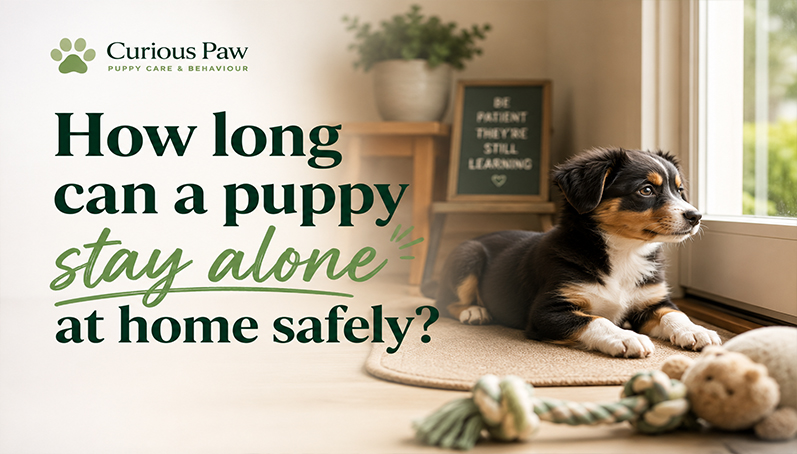
The guideline most veterinary sources agree on: one hour per month of age, up to a maximum of around four to six hours for puppies approaching adulthood. According to VCA Animal Hospitals, a 2-month-old puppy shouldn’t be left alone for more than two hours; a 3-month-old, three. The AKC notes that puppies under 10 weeks often can’t manage even a single hour reliably. These aren’t arbitrary numbers — they track closely with bladder development and the physiological reality of what a young dog can physically hold.
Under calm, resting conditions, those limits might stretch slightly. Under stimulation — after eating, after play, after waking from a nap — the window shrinks. A 12-week-old Cockapoo that just finished a meal and a play session has maybe 45 minutes before the bladder becomes urgent, regardless of what the age-based chart suggests. One thing that surprises a lot of owners: a puppy that seems perfectly settled in the crate after lunch will often wake up from a short nap and need to go within ten minutes, with almost no warning. The post-nap urgency is real and faster than most people expect.
There Are Two Separate Problems Here
Bladder capacity is the first. Emotional development is the second, and it’s the one most owners don’t think about until something goes wrong.


The first four months of a puppy’s life are a critical socialization and attachment window. A puppy left alone for large portions of every day during this period — even within the bladder-appropriate time limits — can develop anxiety, fearfulness, and difficulty settling that persist well into adulthood. Being alone isn’t just a physical ask. It’s a psychological one, and the nervous system of an 8-week-old isn’t equipped for prolonged isolation the way an adult dog’s is.
The difference between a puppy that handles alone time comfortably at six months and one that doesn’t is almost always in how that alone time was introduced. Short, positive, gradual exposure — starting with minutes, building to hours — teaches the puppy that departures are temporary and that the world doesn’t end when you leave the room. Jumping straight from “always home” to “eight hours alone” on the first day back at work produces a very different result.
Eight Hours Is Too Long
A full workday is genuinely too long for a puppy under five months. This isn’t flexible guidance — it’s physically impossible for a young puppy to hold their bladder that long, and emotionally taxing even for older ones. Accepting that reality is more useful than trying to find a workaround that doesn’t exist.
What working owners can actually do: a dog walker or neighbor who comes midday, around the three to four hour mark, splits the day into manageable chunks. Puppy daycare does the same while providing socialization — and a well-run facility requires vaccination records and maintains age-appropriate groupings, which matters more than owners sometimes realize. Even a family member who can pop in for fifteen minutes makes a genuine difference, not just for the bladder but for the puppy’s sense that the world is still functioning normally.
Puppy pads as a bridge during the first months aren’t ideal from a housetraining perspective, but they’re far better than a puppy left without any relief option for eight hours. A designated pad area in a gated zone prevents the situation where a puppy is forced to eliminate in their sleeping space — which sets housetraining back significantly and causes real distress. Making a pragmatic choice about pads during the working phase isn’t a failure of commitment to outdoor training. It’s reality management.
Teaching a Puppy That Alone Is Safe
The most effective thing any owner can do before returning to a regular schedule is build the alone-time association deliberately. Not leaving for hours and hoping for the best — leaving for five minutes, coming back calmly, leaving for ten minutes, coming back calmly. Each successful short absence teaches the puppy that the owner’s departure isn’t permanent and doesn’t signal danger.
Keeping departures and arrivals low-key makes a measurable difference. Long, emotional goodbyes amplify the contrast between “here” and “gone.” An excited homecoming — the owner bursting through the door as if returning from a long voyage — tells the puppy that the absence was a significant event worth celebrating, which reinforces the idea that being alone is abnormal and distressing. A calm exit and a quiet hello on return communicate the opposite. It feels slightly cold the first few times. It produces a noticeably more settled puppy within a week.
A crate or gated area rather than free run of the house keeps the alone-time experience manageable for both puppy and owner. An unsupervised puppy loose in a large space isn’t just a housetraining problem — it’s a safety issue and an anxiety-producing amount of territory for a dog that hasn’t developed the confidence to navigate it alone.
Signs the Alone Time Is Too Much
Accidents despite age-appropriate timing. Destruction focused near exits — the door frame, the window sill — rather than random chewing. Excessive barking that neighbors report starting shortly after departure and continuing. A puppy that takes an unusually long time to settle after the owner returns, pacing or vocalizing rather than relaxing. These patterns compound quickly if ignored, and a camera that connects to a phone tells an owner far more about what’s actually happening during absences than coming home to evidence ever will.
True separation anxiety — clinical distress rather than ordinary adjustment difficulty — is a different category and doesn’t respond to management strategies alone. According to Texas A&M’s College of Veterinary Medicine, behaviors from genuine separation anxiety occur consistently every time the owner is absent and often escalate over time. A veterinary behaviorist is better positioned to address it than any schedule adjustment.
The honest version of this: leaving a puppy alone for extended periods in the first months, before they’ve had the chance to learn that alone time is safe, creates problems that take longer to fix than the convenience was worth. Taking time off or arranging midday support during the first four to six weeks is an investment in a dog that, by six months, can handle a reasonable workday without distress. The owners who skip that step sometimes spend the next year managing the anxiety it produced.
- VCA Animal Hospitals — New Puppy Guide: Vet Care, Training & Supplies
- American Kennel Club — How Long Can You Leave a Puppy Alone?
- Texas A&M College of Veterinary Medicine — Home Alone: Separation Anxiety in Dogs