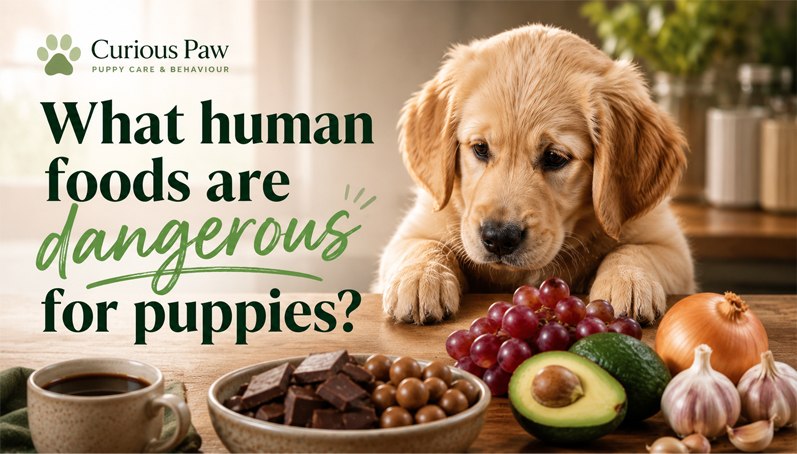
Human food was the second most common cause of pet poisoning calls to the ASPCA in 2024 — accounting for 16.1% of all exposures reported to their Animal Poison Control Center. That’s not counting the calls that never happened because the owner didn’t realize what the dog got into.
Most of those incidents weren’t owners deliberately feeding something harmful. They were a grape rolling off the counter, a sugar-free gum wrapper on the floor, a child sharing a bite without thinking. Puppies are especially vulnerable — smaller body weight means a smaller toxic threshold, and they’re low to the ground and indiscriminate about what they eat in a way that adult dogs often aren’t.
What follows covers the foods that genuinely matter — the ones that cause real physiological damage, not just an upset stomach — ranked by how dangerous and how commonly encountered they actually are.
The Ones That Can Kill
Xylitol
This is the one that catches the most owners off guard, because it hides in products nobody associates with danger. Xylitol is an artificial sweetener found in sugar-free gum, certain peanut butters, some yogurts, chewable vitamins, melatonin supplements, and toothpaste. According to VCA Animal Hospitals, when a dog eats xylitol it triggers a massive release of insulin from the pancreas — blood sugar can crash to dangerous levels within 10 to 60 minutes of ingestion.
The peanut butter issue specifically trips up new puppy owners because peanut butter is a standard recommendation for stuffing Kongs and giving pills. Most mainstream brands are safe. But some “natural” and sugar-free varieties contain xylitol — brands including Go Nuts Co., Krush Nutrition, Nuts ‘N More, and P28 have been flagged by veterinarians. Read the label every time, even if it’s the same brand you’ve bought before, because formulations change. Any ingredient ending in “-itol” is worth looking up.
Symptoms can appear in under an hour. Vomiting, weakness, loss of coordination, seizures. If you know your puppy got into anything containing xylitol, call your vet or ASPCA Poison Control (888-426-4435) immediately — don’t wait for symptoms.
Grapes and Raisins
The toxicity of grapes and raisins in dogs is one of the stranger puzzles in veterinary medicine — the exact substance that causes harm still isn’t confirmed, though tartaric acid is the current leading theory. What is confirmed: even a small amount can cause acute kidney failure in some dogs. The unpredictability is the problem. One dog eats several grapes with no visible effect; another goes into kidney failure from two. There is no established safe dose, which means any ingestion should be treated as a potential emergency.
Raisins are more concentrated and therefore more dangerous by volume. Trail mix, oatmeal raisin cookies, fruit cake, certain cereals — these are the hidden sources. A puppy getting into a bag of trail mix on the coffee table is not a trivial event.
Chocolate
Chocolate contains theobromine and caffeine — two compounds dogs metabolize far more slowly than humans do. The type matters significantly. Dark chocolate and baking chocolate contain much higher concentrations of theobromine than milk chocolate; a small square of baking chocolate can be genuinely dangerous for a puppy-sized dog in a way that a small amount of milk chocolate might not be. That said, no form of chocolate is safe, and for small puppies the threshold is lower than people realize.
The ASPCA’s 2024 data shows chocolate accounting for 13.6% of all poison control calls — the fourth most common overall. The calls spike around Halloween, Valentine’s Day, and Christmas, which tells you where the exposure is happening.
Dangerous, Not Immediately Fatal — But Still Serious
Onions, Garlic, and the Rest of the Allium Family
Raw, cooked, dried, or powdered — all forms damage a dog’s red blood cells, causing hemolytic anemia that can develop over several days. Garlic is the most potent of the group. The delayed timeline is what makes this one catch owners off guard: a dog that ate something seasoned with garlic on Monday may not show weakness, pale gums, or labored breathing until Wednesday or Thursday.

The hidden sources are the ones that matter most — onion powder and garlic powder appear in broths, seasoning blends, baby food, and leftovers. A puppy that helps itself to a piece of seasoned chicken has likely had some exposure. It’s not always an emergency, but it warrants a call if you know it happened.
Macadamia Nuts
Less commonly known but worth understanding. According to the ASPCA, macadamia nuts cause weakness, tremors, vomiting, and elevated body temperature in dogs — symptoms that appear within 12 hours and can last up to 48. They’re also high in fat, which means even a non-toxic quantity raises pancreatitis risk. The typical scenario is a dog getting into macadamia nut cookies or a mixed nut bowl at a gathering.
Raw Bread Dough
This one surprises most people. Raw yeast dough continues to rise inside the warm environment of a dog’s stomach, which can cause painful bloating and in serious cases gastric distension requiring emergency treatment. The fermentation process also produces ethanol — meaning a puppy that eats raw dough can experience alcohol poisoning on top of a swollen stomach. It’s the kind of thing that happens during holiday baking when you leave the kitchen for ten minutes.
Quick Reference: Danger by Category
How Puppies Actually Get Into These Things
It’s almost never deliberate feeding. A grape rolls off the cutting board and the puppy is there before you process what happened. A child shares a piece of chocolate because they don’t know. Someone puts their bag down and the puppy works open a pocket that had gum in it. Guests feed table scraps without asking. The garbage has something in it.
Puppies also get into trash reliably and enthusiastically. If you cook with onions or garlic — or if any of the items above have recently gone in the bin — a lidded trash can isn’t overcaution, it’s just practical. The same goes for bags left at floor level, especially purses that might contain gum or mints.
Coffee grounds are worth specific mention because they’re a surprisingly common exposure. Dogs are often attracted to the smell and will eat them out of a trash can or off a countertop. Used grounds have the same caffeine concentration as fresh ones. A small puppy getting into a used filter from a morning pot is not a trivial event.
If Your Puppy Eats Something Toxic
The two numbers worth saving in your phone before you need them:
Pet Poison Helpline: (855) 764-7661 — 24/7 alternative
Call before symptoms appear. With xylitol especially, waiting until the puppy looks sick means waiting until the blood sugar has already crashed. The treatment window is narrow and being on the phone with poison control while the puppy still seems fine is almost always better than waiting 45 minutes to see what develops.
Don’t induce vomiting without guidance. It’s the right move for some toxins and the wrong move for others — a vet or poison control line will tell you whether it’s appropriate and how to do it safely.
The Peanut Butter Check You Should Do Today
Go find whatever peanut butter you have in the house right now. Flip it over and scan the ingredients for xylitol — it may also be listed as birch sugar, birch bark extract, or wood sugar. Most mainstream brands (Jif, Skippy, Peter Pan) are safe. Natural, low-sugar, and keto-friendly varieties are where xylitol tends to appear. If you find it, it’s not safe for your puppy. Replace it with one that doesn’t contain it and you’ve removed one of the more common hidden dangers from your kitchen.
Most owners do this check once and don’t think about it again — which is fine, until the brand changes its formula. Worth a quick scan every time you buy a new jar.
- ASPCA — People Foods to Avoid Feeding Your Pets
- ASPCA — The Official Top 10 Toxins of 2024
- VCA Animal Hospitals — Xylitol Poisoning in Dogs
- American Kennel Club — People Foods Dogs Can and Can’t Eat
- MedVet — Xylitol Poisoning in Dogs: Signs, Treatment, and Identifying Xylitol-Containing Products
- Modern Dog Magazine — Don’t Feed This Type of Peanut Butter to Your Dog