
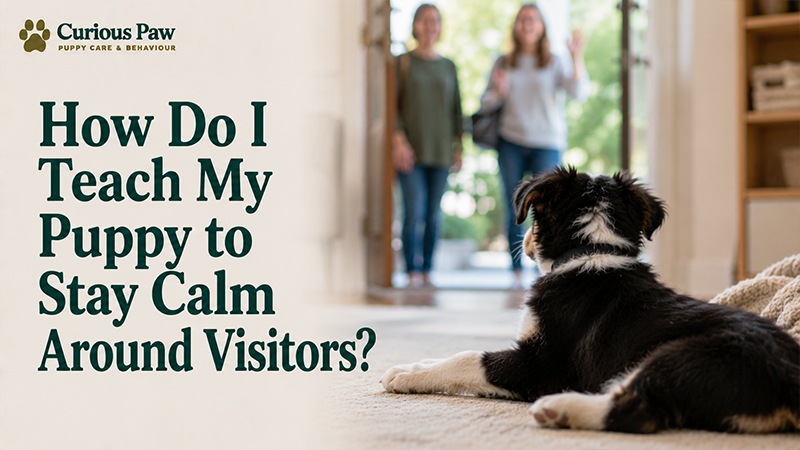
The doorbell rings. The puppy goes from zero to chaos in about half a second — barking, spinning, launching itself at whoever comes through. By the time the guest is in the hallway, the situation is already out of control and the owner is apologizing. The training instinct is to work on calming the puppy down after this has happened. That’s the wrong point of intervention. The moment to manage is before the door opens, not after it.
Why Arrivals Are So Hard
The doorbell and the knock are among the highest-arousal triggers in a puppy’s environment. They reliably precede something exciting — a person appearing — and the anticipatory arousal that builds between the sound and the appearance is often where the worst behavior happens. A puppy that’s already at maximum excitement before the door opens can’t make good behavioral choices once it does. The intervention that matters is reducing that arousal before the puppy reaches the door, not managing behavior once it’s already peaked.
This is also a behavior where owner energy compounds the problem. An owner who rushes to the door saying “hang on, hang on” while the puppy spins and barks is communicating that the doorbell is a high-energy event worth getting excited about. A calm, deliberate response to the doorbell — not slow, but intentional — models the energy the owner wants to see.
The Leash Before the Doorbell
When visitors are expected, clip a leash to the puppy before the doorbell rings. Not after — before. A leashed puppy at the door can be gently prevented from launching into the guest, kept at a manageable distance while the greeting begins, and guided into a sit or settle without a chase around the hallway. A leash doesn’t train the puppy, but it prevents the repeated rehearsal of frantic greetings that reinforces the behavior. Every calm, controlled arrival the puppy experiences builds a slightly different expectation about what arrivals look like. Every chaotic one reinforces the existing pattern.


For unexpected arrivals — deliveries, unannounced visitors — keeping a leash near the door so it can be grabbed in the few seconds between the knock and opening is a practical habit worth building. It takes one month of doing this consistently before reaching for the leash becomes automatic before opening the door.
Send the Puppy Somewhere
A “place” or “mat” cue — sending the puppy to a specific spot and keeping them there until released — is the most practical tool for managing visitor arrivals. A puppy that goes to their mat when the doorbell rings gives the owner time to open the door, greet the guest, and allow things to settle before the puppy is released to say hello. The guest arrives into a calm environment. The puppy gets released to greet a guest who is already still and settled rather than mid-arrival and full of energy.
Building this requires the mat/place behavior to already be solid before trying to use it during actual arrivals. Practicing with staged arrivals — a family member going out and coming back, a neighbor willing to knock on cue during a training session — lets the owner build the behavior in a controlled scenario before the chaos of a real unexpected visitor. The real arrival is too stimulating to be where training begins. It’s where the trained behavior gets applied.
Brief the Guests
Guests are one of the most underused training resources available, and one of the most common sources of accidental reinforcement of excited behavior. A guest who bends down to engage with a jumping puppy, makes high-pitched excited noises, and says “oh it’s fine, I love puppies” has reinforced jumping while the owner was trying to prevent it. That’s not the guest’s fault — they didn’t know. Briefing guests before they arrive (“she’s working on calm greetings, could you ignore her until she’s sitting?”) produces dramatically different interactions than assuming guests will intuitively know what to do.
The ask is simple and most people are happy to comply: wait until the puppy is sitting or settled before engaging. No eye contact, no touch, no talking to the puppy while they’re excited. The moment four feet are on the floor or the puppy is sitting — calm attention, a treat if available, quiet praise. Guests who follow this for even one or two visits become genuinely useful training partners rather than obstacles to the training.
When the Puppy Is Frightened Rather Than Excited
Some of what looks like excitement at the door is actually anxiety — barking and spinning that comes from fear of the unknown person rather than enthusiasm for them. The distinction matters because the training approach is different. An excited puppy needs a structured alternative behavior and a calmer arousal level. A fearful puppy needs gradual positive exposure to visitors at a distance and pace they can manage, with the puppy in control of how close they get.
The tell: an excited puppy approaches and makes contact, then bounces away to bounce back. A fearful puppy barks from a distance, retreats when the person moves toward them, and may show stiff body posture, whale eye, or persistent avoidance. Treating fear-based behavior as excitement-based leads to approaches that increase anxiety rather than reduce it. When in doubt — if the behavior seems more about avoiding the visitor than engaging with them — that’s worth a conversation with a trainer before the pattern becomes entrenched.
Frequently Asked Questions
My puppy goes crazy every time someone comes to the door — is there a quick fix?
The quickest practical fix is management before the door opens: clip the leash before the doorbell rings, and use it to prevent the puppy from reaching the guest in an uncontrolled state. That doesn’t train the behavior, but it stops the repeated rehearsal of chaotic arrivals while training is in progress. The training itself — a reliable mat or place cue, practiced with staged arrivals before real ones — takes several weeks of consistent work to become reliable in the high-arousal scenario of an actual visitor.
My puppy is fine with family but goes wild with strangers — why?
Novelty is a major arousal driver. Familiar people have lost their novelty over time and the puppy’s response has settled accordingly. Strangers are new, which makes them more exciting or potentially more triggering depending on the puppy’s temperament. The training response is the same — practice the calm greeting behavior specifically with unfamiliar people, starting with calm strangers willing to ignore the puppy until it settles, and building up to more enthusiastic arrivals as the behavior becomes reliable.
How do I stop my puppy from jumping on guests when I can’t control the guests?
Management is the answer when guest behavior can’t be controlled. Keep the puppy on a leash until the greeting is settled and the guest has been briefed. A baby gate between the puppy and the entrance gives you time to explain the rules before the puppy has access. Alternatively, crate or gate the puppy during arrivals until the initial excitement settles, then allow a controlled greeting. Guests who insist on engaging with a jumping puppy despite being asked not to are a real obstacle — leash management is the only tool that works reliably regardless of what the guest does.
The puppy that greets visitors calmly at six months got there partly through training and partly through guests who followed instructions and didn’t reward the chaos. Both matter. Getting the humans in the equation on board is at least as important as the training itself.
- American Kennel Club — How to Teach Your Dog to Go to Their Place
- Rover — How to Keep a Dog Calm Around House Guests
- Dogster — How to Keep Your Dog Calm When Guests Arrive