
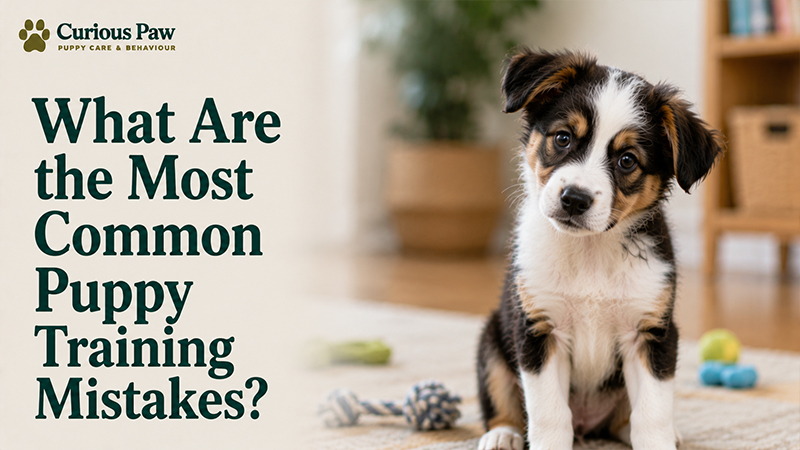
The most common training mistake isn’t choosing the wrong method or using the wrong treat. It’s what happens in the hours between formal training sessions — the 23 hours a day when nobody is actively training, and the puppy is being quietly taught things nobody intends to teach them. A puppy that spends two minutes a day practicing “sit” and the rest of the day learning that jumping produces excited human attention, that barking gets the food bowl placed faster, and that the bedroom is somewhere they’re always allowed to sleep has received a training curriculum. Just not the intended one.
Allowing Things Because They’re Cute
A 10-week-old puppy jumping up is endearing. The same behavior in a 50-pound dog at 10 months is a problem. The jumping was trained in the window between those two points — every excited greeting that produced contact and eye contact taught the puppy that jumping is the correct greeting behavior. By the time it stops being cute, the habit is established.
This is the dynamic behind most of the behavioral problems new owners face at six months: behaviors that were acceptable, encouraged, or simply not addressed when the puppy was small and manageable have been practiced hundreds of times and are now entrenched. Sleeping in the bed is fine if it’s an intentional choice — but if it’s happening because the puppy cried and it seemed easier than the crate, and now a 60-pound dog is sleeping in the bed permanently and the owner would prefer otherwise, removing that privilege produces significant pushback. The habit was built without a decision being made. The best time to decide what the adult dog’s rules will be is the first week the puppy comes home, not six months later.
Repeating Cues Until They Mean Nothing
This one is covered in more detail in the recall and the “won’t listen outside” articles, but it’s so universal that it belongs in any list of training mistakes. Saying “sit, sit, sit” until the puppy sits teaches the puppy that responding to the first repetition is optional — the actual signal is the third or fourth one. Saying “come, come, come” when the puppy is investigating something interesting teaches that “come” is background noise that doesn’t require any particular response.


Say the cue once. If the puppy doesn’t respond in a few seconds, either help them into the behavior or reduce the distraction level and try again. Every repetition of an ignored cue makes the cue slightly less meaningful. The rule that protects the training: ask once, make it happen, reward. Not ask seven times and eventually give up.
Inconsistency Across People and Situations
A puppy that’s not allowed on the sofa except when grandma visits, or not allowed to jump except when the owner comes home excited to see them, or told “leave it” for the kitchen scraps but fed from the table at dinner is receiving inconsistent information about what the rules are. Dogs learn from patterns. When the pattern isn’t consistent, the learning isn’t either — the puppy learns that rules are variable and context-dependent, which produces a dog that tests the rules rather than following them.
Everyone who interacts with the puppy regularly needs to apply the same rules. This isn’t about rigidity — it’s about the puppy receiving consistent information about what’s expected. Inconsistency doesn’t just slow training, it actively undermines it. A behavior that’s been reinforced intermittently — allowed sometimes, corrected other times — is more persistent than one that’s been reinforced consistently, because the puppy has learned that persistence eventually produces the reward.
Training Sessions That Are Too Long
Five minutes of focused, successful training produces more learning than 20 minutes of cycling through commands as the puppy’s attention deteriorates. Young puppies have genuinely short attention spans, and a session that continues past the point of engagement produces errors, frustration, and a puppy that starts associating training with something tedious. The session should end when the puppy is still engaged and succeeding — not when they’ve clearly checked out and started doing something else.
Three five-minute sessions spread through the day outperform one 15-minute block. The spacing allows the brain to consolidate what was practiced between sessions, and the short duration keeps the puppy’s engagement high throughout. The owner who “does training” for 20 minutes once a week and expects results is using the same hours of training time as the owner doing three minutes twice a day — but the second approach produces dramatically faster progress.
Punishing After the Fact
A puppy punished for an accident discovered after the fact, or for destruction that happened while the owner was out, cannot connect the punishment to the behavior. They connect it to the owner’s arrival, or to the presence of the owner in that location, or to the specific emotion the owner is displaying. The result is typically a puppy that becomes anxious around the owner’s return, learns to hide evidence, or develops confusion that complicates rather than improves training.
The ASPCA is explicit on this point: punishment for found behavior is reliably ineffective and often creates problems that didn’t exist before. The management response to a found accident or destruction is to clean it up and adjust the supervision strategy — not to find the puppy and respond to them emotionally.
Expecting the Behavior to Transfer Automatically
A sit trained in the kitchen doesn’t automatically transfer to a sit at the park. A recall that works in the backyard doesn’t automatically work near another dog. Dogs don’t generalize well across contexts, and behaviors need to be practiced in the environments where they’ll be needed. The owner who trains extensively at home and then expects perfect performance in high-distraction environments hasn’t done the training that matters for those environments — they’ve done the training for home.
Taking trained behaviors into new environments — one at a time, with lower expectations and higher rewards than the familiar setting — is how proofing works. Not expecting transfer to happen automatically, but building it deliberately, environment by environment and distraction level by distraction level.
Stopping When Things Get Good
Training doesn’t end when a behavior seems reliable. Behaviors that aren’t maintained gradually fade. A recall that was solid at six months and stopped being reinforced becomes unreliable at 18 months. A dog that sat beautifully at a year but hasn’t been asked to sit in six months will sit, but not as snappily or as reliably as before. Maintenance doesn’t require formal training sessions — it requires occasional practice and occasional rewards in real-life situations. Randomly rewarding good behavior that happens naturally, reinforcing cues occasionally in daily life, keeping the puppy engaged with the training relationship over time. The dog that gets reinforced for coming when called at 18 months and 3 years is a different dog from one who got reinforced intensively at 6 months and then forgotten.
Training a puppy well in the first year is the most efficient investment any owner can make in the next decade of living with that dog.
- American Kennel Club — 5 Common Dog Training Mistakes to Avoid
- American Kennel Club — Common Dog Training Mistakes and How to Avoid Them
- ASPCA — Destructive Chewing (on punishment for found behavior)