
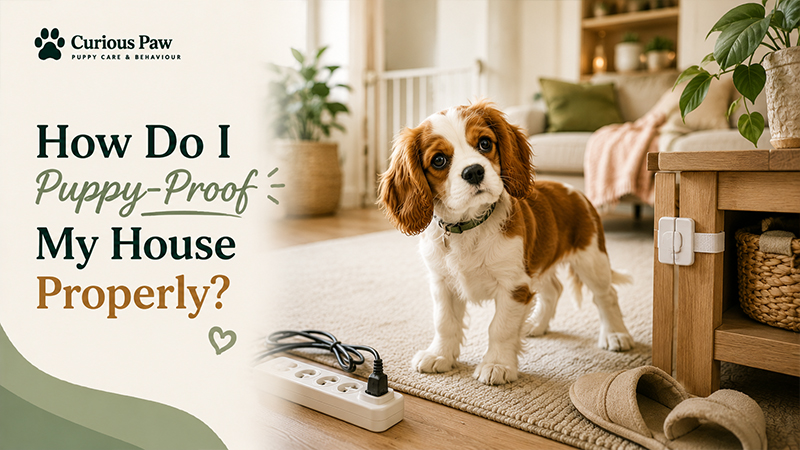
Before you do anything else, get on your hands and knees and actually look at your home from floor level. Not as a symbolic gesture — as a practical exercise. The hazards that send puppies to emergency vets are almost never the obvious ones owners think about in advance. They’re the charging cable that’s been sitting behind the couch for two years, the decorative plant on the low shelf that’s been there so long nobody thinks of it as a plant anymore, the bathroom trash can that’s never had a lid because it never needed one. The difference between floor-height perspective and adult-standing perspective is genuinely significant.
Puppy-proofing isn’t a one-afternoon project that gets finished. It’s a habit of noticing things. But there’s a specific window — the weeks before and immediately after the puppy arrives — when doing the bulk of the work pays off most. After that, you’re fixing problems rather than preventing them.
The Kitchen Deserves the Most Attention
The kitchen is where the highest-density hazards live. Trash cans are the single most consistent source of trouble — a standard step-pedal bin is no obstacle for a curious puppy, and kitchen trash contains a remarkable concentration of things that cause harm: grape stems, garlic skins, onion peels, coffee grounds, chocolate wrappers, cooked bones, fatty scraps. A lidded trash can with a locking mechanism, or one moved inside a latched cabinet, solves the problem permanently. An unlocked cabinet under the sink usually holds drain cleaner, dishwasher pods, and other products that cause serious chemical burns. Cabinet latches cost almost nothing and take ten minutes to install.
Counter edges matter more than people expect. Coffee grounds left in a French press within reach, a bag of sugar-free gum pushed to the back of the counter, a bottle of ibuprofen left near the kettle — puppies develop counter-surfing ability faster than most owners anticipate. A 12-week-old Beagle can’t reach a standard counter. A 16-week-old one often can, depending on what they’re motivated by. Keeping low surfaces clear before the puppy arrives is easier than developing new habits under pressure.
Living Spaces and the Cord Problem
Electrical cords are the hazard that gets mentioned in every puppy-proofing list and still catches people off guard, because the actual scope of the problem in a modern home is larger than it sounds. Phone chargers, laptop cables, TV power cords, lamp cords, gaming controllers, extension leads — most living rooms have eight to twelve separate cords within chewing reach if nobody has deliberately addressed them. A puppy chewing through a live cable can suffer severe burns or electrocution. Running cords through PVC pipe, using cord concealers from a hardware store, or tucking them behind furniture completely solves this. Coiling the cord and hoping the puppy doesn’t notice it doesn’t.


Houseplants deserve more attention than they typically get. Sago palm is one of the most toxic substances a dog can encounter — even a small amount causes liver failure and the survival rate for significant ingestion is poor. Pothos, philodendron, and peace lily are extremely common houseplants that cause oral irritation and vomiting. Tulip and daffodil bulbs can cause cardiac issues in meaningful quantities. The ASPCA maintains a comprehensive toxic plant list online. Most plants don’t have to leave the home — they just need to move somewhere the puppy cannot access, which usually means a high shelf or a room that stays closed.
Small objects on low surfaces are a consistent source of emergency vet visits. Coins, batteries, children’s toy components, remote controls with accessible battery compartments, hair ties, rubber bands — puppies eat things that seem obviously inedible to humans. Batteries are a specific concern because the contents cause internal chemical burns if a puppy chews through one. The habit of keeping low surfaces clear takes about a week to develop and prevents a disproportionate number of problems.
Bathroom and Medications
Human medications are the leading cause of pet poisoning calls to the ASPCA’s Animal Poison Control Center. Every year. By a significant margin. The issue isn’t just prescription medications — ibuprofen and acetaminophen are both toxic to dogs in small doses, children’s liquid Tylenol left on a low shelf is a common exposure, and vitamins and supplements in chewable form can be accidentally overdosed because puppies find them appealing. A closed, latched cabinet is the only reliable solution. Childproof lids aren’t — a motivated puppy can chew through one faster than most adults can open it.
Bathroom trash cans are another overlooked hazard. Used razors, dental floss, cotton swabs, medication packaging, personal care products with fragrance compounds — these become interesting to a puppy that gets unsupervised access. A lidded bathroom bin is a cheap, permanent fix. Keeping the toilet lid down prevents both drinking from the bowl (cleaning products in the water are toxic) and the less common but real drowning risk for very small puppies.
Garage and Utility Areas
If the puppy will ever have access to a garage, this area needs serious attention before that happens. Antifreeze is the most dangerous common garage substance — it tastes sweet to dogs and even a small amount of the ethylene glycol variety causes fatal kidney failure. Any spill on the garage floor should be cleaned immediately and completely. Antifreeze containing propylene glycol is significantly less toxic if you’re willing to switch brands. Rodenticides placed and forgotten along walls are a consistent problem — they’re designed to be attractive to small mammals, and a puppy finding a bait station is a genuine emergency.
The washing machine and dryer are worth mentioning because puppies investigate warm, enclosed spaces. Checking before starting a load becomes automatic after a week. A puppy that crawls inside an unattended front-loading machine doesn’t have the strength or leverage to get back out.
The Yard
Walk the fence perimeter at ground level before the puppy comes home. Look for gaps at the bottom where the ground has eroded, loose boards, and anywhere the fencing doesn’t meet the ground cleanly. Most puppy escapes happen under fences, not over them — a gap that looks too small for a puppy to fit through often isn’t. Pools need a barrier with a self-closing gate regardless of whether the puppy can swim, because exhaustion and inability to find an exit point are genuine risks even for dogs that know how to paddle.
Mushrooms growing in the yard should be removed. Some varieties cause liver failure in dogs, and puppies investigate mushrooms the same way they investigate everything else — mouth first. Lawn treated with fertilizers, herbicides, or pesticides should be kept off-limits until fully dry, and any professional lawn service should know a puppy is now part of the household.
Start Small and Expand
The most practical approach to puppy-proofing isn’t trying to make the entire house safe on day one. It’s starting with one or two rooms and expanding access as trust is established. A kitchen or living room where hazards have been properly addressed is a manageable starting zone. A whole house done in a hurry almost always has gaps — the back bedroom nobody thought about, the home office with cables everywhere that “the puppy won’t go in anyway.”
Baby gates are the practical tool that makes this work without requiring permanent changes to the home. Two or three gates — at staircases, doorways to unsupervised rooms, and wherever the puppy’s zone ends — contain the scope of the problem and prevent the majority of incidents. A puppy that can only get into a properly prepared room cannot get into trouble in rooms that weren’t prepared.
Six months from now, the puppy has enough judgment to navigate a broader range of the house safely, the teething phase is largely over, and the household has adapted around the dog in ways that feel natural rather than effortful. The work done in the first few weeks is what gets you there without a detour through the emergency vet.
Frequently Asked Questions
What’s the most dangerous thing in a typical house for a puppy?
Human medications consistently top the list of pet poisoning calls to the ASPCA. Ibuprofen and acetaminophen are both toxic in small doses, and puppies can chew through childproof lids faster than most adults can open them. A closed, latched cabinet is the only reliable solution. After medications, unsecured trash cans containing food scraps and antifreeze in accessible garages are consistently responsible for the most serious incidents.
Do I really need to puppy-proof every room before they arrive?
No — and trying to do the whole house at once usually means doing it poorly. Start with the one or two rooms the puppy will actually spend time in and use baby gates to block everything else. Expand access gradually as the puppy earns it and as you understand their specific habits and curiosity level. A thoroughly prepared small zone is safer than a hastily prepared whole house.
My puppy keeps getting into the same spot no matter what I do — why?
Usually because something in that location is genuinely attracting them — a smell from a previous spill, food residue, an interesting texture, or something stored nearby that they can detect but you can’t easily see. Get down at puppy level and look carefully. If the area has had food contact at any point, cleaning with an enzymatic cleaner removes residual odors that standard products leave behind.
- VCA Animal Hospitals — How to Puppy-Proof Your House
- ASPCA — Toxic and Non-Toxic Plants List
- PetMD — How to Puppy-Proof Your House