The most important thing to know before attempting to remove a mat: never wet it first. Wetting a mat causes the fibers to contract and tighten, making it significantly harder to work out and closer to the skin. The instinct to loosen a mat with water makes it worse. Work on dry fur only, with a detangling spray applied to soften — not water. This one reversal of instinct changes the outcome of most at-home mat removal attempts.
Where Mats Form and Why
Mats develop in areas of friction — behind the ears, under the collar, in the armpits, between the hind legs, around the base of the tail, and anywhere a harness rubs regularly. In curly and wavy-coated breeds (Poodles, Doodles, Bichons, Cocker Spaniels), shed hair doesn’t fall out but gets trapped in the living coat. As it accumulates, it tangles with the surrounding hair, tightens with movement and moisture, and eventually becomes dense enough to pull on the skin. According to the AKC, mats form most consistently in areas of frequent movement and contact — exactly where regular brushing is hardest to do thoroughly.
The puppy-to-adult coat transition period in curly and wavy breeds — roughly 6 to 18 months — is when matting is most severe. The soft, fine puppy coat wraps around the coarser emerging adult coat as it grows in, creating conditions for rapid mat formation even with regular brushing. Doodle owners who didn’t mat-problem in the first 6 months are sometimes surprised by how fast matting develops during this transition. It’s not a grooming failure — it’s the coat doing what this specific change does. Professional grooming appointments every 6 to 8 weeks through this period help significantly.
Prevention: What Actually Works
Regular brushing, specifically, is the only reliable prevention. The frequency depends on coat type: daily for curly and wavy coats, every 2 to 3 days for long straight coats, weekly for most short coats. The technique matters as much as the frequency — line brushing, where the coat is lifted in sections and brushed from the skin outward, reaches the roots where mats form rather than gliding over the surface. Brushing the surface of a long coat without parting to the skin misses where tangles originate.


Brush before and after every bath. Loose hair that isn’t brushed out before bathing will mat in the water. Hair that isn’t thoroughly brushed through during drying will mat as it dries. The bath that seemed to go well can produce significant matting within 24 hours if the coat wasn’t worked through while wet and then again when dry.
After outdoor activity in wet conditions, brush before the coat fully dries. Remove harnesses and collars for brushing — the friction points under collars and harnesses are among the most common mat locations and can’t be properly brushed while the equipment is on.
Removing Mats at Home
Assess first. Run a finger between the mat and the skin. If a finger fits comfortably, the mat may be workable at home. If you can’t get a finger between the mat and skin, it’s too close and too dense — this is a professional job, not a home one. Attempting to remove a mat that close to the skin at home risks cutting the skin and causes significant pain.
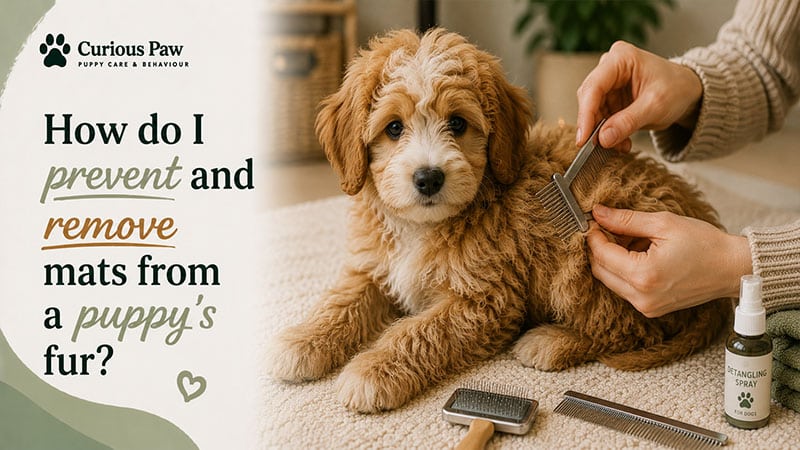
For workable mats: apply a dog-safe detangling spray to the mat and allow it to sit for a few minutes. Work the mat from the outside edges inward with fingers first — physically separating the outer fibers before bringing in any tools. Always work from the tips toward the skin, never the reverse. A dematting comb or slicker brush works in small sections, with one hand holding the hair close to the skin to prevent pulling the skin rather than the hair. The skin hold is not optional — without it, mat removal is painful regardless of how gentle the brush strokes are.
Progress is measured in small sections. A significant mat may take 10 to 15 minutes of patient work. If the puppy becomes distressed, stop. A partial mat is better than an experience that makes future grooming harder. Continue in a separate session.
When to Cut
Some mats can’t be detangled and need to be cut. Use blunt-ended scissors for safety. Cut into the mat parallel to the hair direction — never perpendicular to the skin, and never with pointed scissors near a puppy that’s moving. Cutting the mat into sections (not through the mat from one side to the other) makes detangling the sections possible without removing all the hair. When the mat is too close to the skin to safely cut at home, shaving is the only option — which is a groomer’s job with a professional clipper, not scissors.
When to Go to the Groomer
If a finger won’t fit between the mat and the skin, go to the groomer. If the mat is in a sensitive area — behind the ear, in the armpit, between paw pads, near the genitals — go to the groomer. If the puppy is showing signs of skin irritation or redness under the mat, go to the groomer. If more than a quarter of the coat is matted, go to the groomer. Severe matting that can’t be detangled requires a shave-down, where the entire coat is shaved short and the fresh coat is allowed to grow in without the existing mat burden. It looks dramatic. It’s the most humane outcome for a severely matted dog, and the coat grows back fully.
A mat that can’t get a finger between itself and the skin is a groomer job, not a home job. Everything else is a matter of patience, technique, and the right detangler.