Grooming tolerance isn’t primarily built during grooming sessions — it’s built in the everyday handling between them. A puppy whose owner regularly touches its paws, ears, muzzle, and tail during play and calm time is a puppy that arrives at the grooming table with a body that’s been handled before. The actual grooming desensitization process builds on that foundation rather than starting from scratch. Starting handling before 12 weeks, when the socialization window is still most receptive, produces the fastest results — but any puppy can improve with consistent, positive practice at any age.
Daily Handling: The Foundation
Every day, briefly but deliberately: run hands over the puppy’s back, legs, and belly. Hold each paw for a few seconds. Touch the ears — not just the outside, but gently folding them back and touching the inner flap. Open the mouth briefly and touch the teeth and gums. Lift the tail. Touch the area under the tail. Each of these locations is somewhere a groomer or vet will need access to, and a puppy that has been touched there regularly finds it unremarkable when a stranger does it. A puppy that’s only been petted on the head and back finds many of these locations alarming when first encountered by a professional.
Pair every unfamiliar touch with a treat or with the activity the puppy finds most rewarding at that moment. The sequence matters: the touch comes first, then the treat. This is the counter-conditioning principle — pairing something the puppy is uncertain about with something unambiguously good, in that order, until the uncertain thing predicts the good thing. Once the association is made, the touch produces anticipation rather than resistance.
Introducing Tools Before Using Them
Every grooming tool needs its own introduction, separate from its use. A brush placed on the floor near the puppy with a treat delivered while the puppy investigates it is a different experience from a brush being applied to the coat the first time. The tool becomes neutral or positive before the grooming action associated with it begins. This applies to the brush, the comb, the nail clippers, the grooming table, the dryer — each one is introduced as an object that predicts treats before it’s used as a grooming instrument.


The process for each tool follows the same progression: present the tool at a distance and reward, move it closer and reward, touch it to the body without using it and reward, use it briefly in one location and reward, expand gradually. According to Best Friends Animal Society’s grooming guidance, even one short brush stroke should be rewarded before building to multiple strokes — the first session ends before the puppy is ready to stop, while the association is still positive, rather than continuing until the puppy objects.
The Lick Mat Technique
A lick mat with a smear of peanut butter, plain pumpkin, or yogurt placed in front of the puppy during brushing turns a grooming session from something that happens to the puppy into something the puppy is doing while brushing happens around it. The licking behavior is self-soothing and focusing, the high-value food keeps attention forward rather than on the grooming, and the activity predicts and competes with the sensation of the brush. Owners who try this for the first time with a previously difficult-to-brush puppy almost always notice an immediate improvement in cooperation — not because the puppy changed its feelings about brushing, but because the lick mat gave it something else to be doing.
Freeze the lick mat the night before for a session that lasts longer. This works particularly well for longer-coated breeds that need more time under the brush.
Building Each Grooming Task
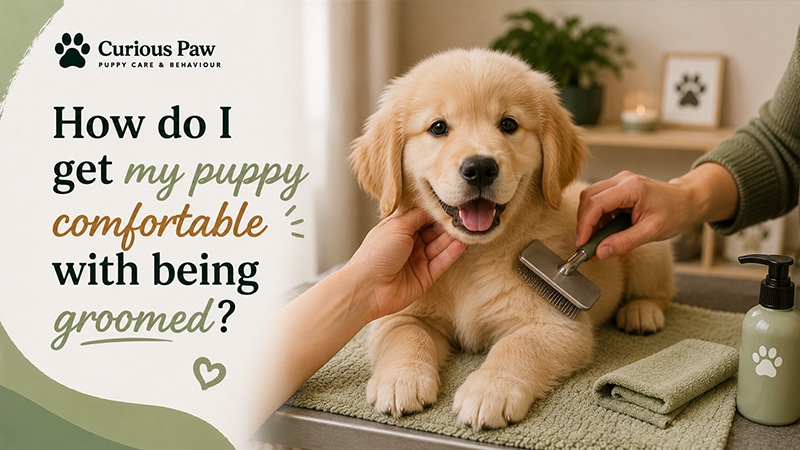
Brushing: Start with a soft brush on a non-sensitive area — the shoulder or the back — for two to three strokes with a treat after each. Add strokes over days, not within a single session. Work toward sensitive areas (belly, legs, behind the ears, around the face) once the non-sensitive areas are reliably tolerated. Switch to firmer brushes only after soft ones are accepted.
Ear cleaning: Lift and look at the ear with a treat. Touch a cotton ball to the outer ear with a treat. Gradually work inward over multiple sessions. The goal is a puppy that holds its head still and looks for the treat when the ear is touched, not one that’s restrained while the ears are cleaned.
Bathing: Introduce the tub before any water. Let the puppy explore it and eat treats inside it without anything happening. Add lukewarm water at ankle depth with a treat for getting in. Wet one paw with a wet cloth before a full bath. Keep the first actual bath short — five minutes, lukewarm water, gentle handling, immediate drying and warmth — and end before any distress begins. Rushing the first bath to get it done properly produces a puppy that anticipates every future bath with dread.
Dryer: Run the dryer in a different room while treats are given nearby, then gradually move it closer over sessions. The dryer’s noise and airflow are significant sensory inputs that need their own desensitization sequence before being applied to the body. Many groomers use the dryer at the end of a session once everything else has been successfully completed — it’s usually the hardest thing for puppies to accept and benefits from being introduced last.
The Professional Groomer Relationship
The work done at home directly determines what happens at the grooming salon. A puppy that has been regularly handled, introduced to grooming tools with positive reinforcement, and has had multiple calm bath and brush experiences arrives at its first professional appointment as a manageable animal. A puppy that has never had its paws touched, never heard a dryer, and never been on a grooming table arrives as a project the groomer has to work around rather than with.
AKC recommends that owners ask other people to participate in handling exercises, since the puppy will need to be handled by strangers — vets, groomers — throughout its life. A puppy that only accepts handling from its primary owner has built partial tolerance. One that’s been handled by multiple people during the socialization window generalizes that tolerance to strangers more readily.
The puppy that finds grooming unremarkable at 6 months was handled during playtime every day from week one. The handling wasn’t formal or extended — a few seconds on each paw, a touch on the ear, a brief look in the mouth. Those moments, accumulated daily, build the tolerance that makes professional grooming possible without sedation, struggle, or fear.