
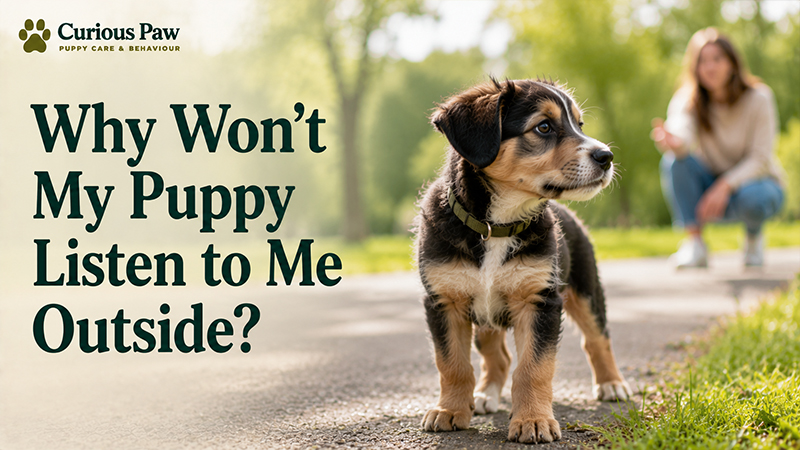
The puppy sits perfectly in the kitchen. Every time. You say “sit” and they sit. Then you take them to the park and say “sit” and they look directly through you at a pigeon. It feels like defiance. It isn’t. The behavior that exists in the kitchen and the behavior that needs to exist at the park are not the same skill at different difficulty levels — they’re essentially different behaviors, because dogs don’t generalize well across environments. The sit your puppy knows is a kitchen-sit. It hasn’t become a park-sit yet, because you haven’t trained a park-sit.
This is the most important concept in dog training that nobody explains to new owners, and once it’s understood, the frustration of the outdoor “disobedience” usually disappears entirely.
Dogs Don’t Generalize — They Situate
A behavior trained in one environment has been trained in that environment. The cue, the context, the sensory landscape, the smells, the sounds — all of it is part of what the dog has learned. Take the same dog, the same cue, and a completely different environment, and the behavior may not exist there at all yet. This isn’t stubbornness or selective obedience. It’s how dogs learn. The good news: once you understand this, the fix is clear. The bad news: it requires actually going to different places and practicing, not just expecting the behavior to transfer.
Trainers call this proofing — building the behavior across multiple environments and levels of distraction until it works regardless of context. A behavior that’s been proofed is reliable. A behavior that’s only been practiced in the living room hasn’t been proofed and shouldn’t be expected to work on a busy street.
The Outdoor Environment Is Overwhelming Competition
Even setting the generalization issue aside, the outdoors presents a fundamentally different cognitive situation than the indoors. Inside, the training treat or toy is probably the most interesting thing in the room. Outside, there are smells from every dog that’s walked past in the last 12 hours, a squirrel somewhere in the vicinity, sounds from a construction site three blocks away, movement at the edge of the puppy’s vision, and the accumulated olfactory history of a piece of grass that’s been visited by dozens of animals. The puppy isn’t ignoring you. They’re overwhelmed, their sensory system is working overtime, and a small piece of chicken and a “sit” cue doesn’t compete well with all of that.


This is why the reward that works indoors often needs to be significantly better outdoors. Not slightly better — meaningfully better. The treat that gets quick responses in the kitchen needs to be upgraded to something genuinely exciting when competing with the outdoor environment. Some puppies need to be fed their entire daily ration during outdoor training sessions in the early stages, because normal-value rewards simply don’t cut through the distraction level.
How to Build Through Distraction
The progression that works: start where the puppy can succeed, then make it incrementally harder. Indoors in a quiet room first. Then outdoors in the yard — already meaningfully harder than indoors. Then on the street in front of the house. Then a quiet parking lot. Then a park at a quiet time. Then a park on a weekend morning. Each step adds distraction, and each step should only be attempted once the puppy is reliable at the previous one.
Distance from the distraction is the variable most owners don’t use enough. A puppy that can’t respond to “sit” when there’s a dog 10 feet away can almost certainly respond to “sit” when there’s a dog 50 feet away. Working at 50 feet and gradually decreasing the distance over multiple sessions produces a puppy that can eventually sit with a dog nearby. Trying to train at 10 feet from the start and getting frustrated when it fails isn’t proofing — it’s setting the puppy up to fail at a level they’re not ready for.
Train Attention Before Commands
A puppy that doesn’t have attention on you outdoors can’t respond to a cue. That’s the more fundamental issue beneath the “won’t listen outside” problem. Before worrying about whether the puppy sits or comes or stays outdoors, focus on building the puppy’s ability to orient to you in an outdoor environment.
A simple attention exercise: stand still outdoors, say nothing, and wait. The moment the puppy voluntarily glances at you, reward immediately. Repeat until the puppy is offering you attention more frequently because they’ve learned that attention produces rewards. This sounds passive but it’s actually building the foundation that makes every other outdoor cue more accessible. A puppy that has learned to check in with you outdoors is a puppy whose attentional habits in the environment have already started to shift.
The Cue Repetition Trap
When a puppy doesn’t respond to a cue outdoors, the instinct is to repeat it. “Sit. Sit. Sit. Sit.” This teaches the puppy that one repetition of the cue doesn’t mean much — the real signal to respond is the fourth or fifth one. Whatever the puppy learns to respond to is what you teach them to respond to. A puppy that hears “sit” four times before sitting has been trained to wait for the fourth “sit.” Say it once. If the puppy doesn’t respond in three seconds, help them into the behavior, reward that, and work on building the cue’s value before asking for it in that environment again.
Short sessions outdoors produce more progress than long ones. Five minutes of focused, successful outdoor training is worth more than 20 minutes of cycling through failed cues. End every session before the puppy loses focus, and always on success. A puppy that ends a session having gotten a series of things right has had a good training session. A puppy that ends a session having gotten increasingly frustrated has had a session that worked against the training goal.
The outdoor environment isn’t a test. It’s a training venue at a higher difficulty level. As soon as it gets framed that way, the approach changes entirely.
- American Kennel Club — Training Your Dog to Ignore Distractions No Matter Where You Are
- American Kennel Club — The Three Ds of Dog Training: Duration, Distance, and Distraction
- American Kennel Club — Is Your Dog Stubborn? Reasons Why Dogs May Not Listen