
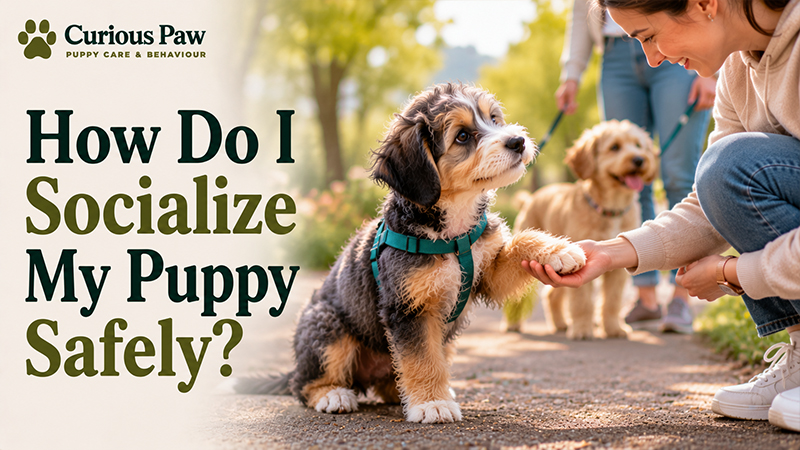
The American Veterinary Society of Animal Behavior has stated something that most new owners never hear: behavioral issues, not infectious diseases, are the number one cause of death in dogs under three years old. Not parvovirus. Not distemper. Behavioral problems — fear, aggression, anxiety — that make dogs impossible to live with and lead to surrender and euthanasia. That statistic reframes everything about how to approach the vaccination-versus-socialization question, and it’s why the AVSAB’s position is that socialization should begin before vaccination is complete.
The Window That Closes
The primary socialization window runs from roughly 3 to 12 weeks, with meaningful receptivity extending to about 16 weeks. During this period, the puppy’s brain processes new stimuli differently than it will for the rest of its life — novel things are more likely to be filed as normal rather than triggering fear responses. After this window narrows, the same stimulus that would have been incorporated calmly at 10 weeks can provoke anxiety at 20 weeks in a dog that wasn’t adequately exposed.
The vaccination series for core vaccines typically finishes at 16 to 18 weeks. The socialization window peaks and begins closing well before that. Waiting for full vaccination before beginning socialization means missing the period of greatest neurological flexibility — and it means spending the following years managing the behavioral consequences of what wasn’t built when the brain was most receptive.
Quality Over Exposure Count
The common mistake in socialization is treating it as a quantity exercise — expose the puppy to as many things as possible, as quickly as possible. Socialization isn’t about exposure. It’s about positive association. A puppy that encounters 15 children in a single afternoon, is grabbed repeatedly, chased, and becomes overwhelmed isn’t socialized to children — they’re sensitized to them in a way that produces fear. One calm interaction with a child who sits on the floor, offers treats, and lets the puppy approach at its own pace is worth far more than five chaotic encounters.


The practical standard: the puppy should be at or below threshold throughout every socialization experience. At threshold means noticing and processing the novel stimulus without fear or overwhelm — curious, investigating, not avoiding. Above threshold means the puppy is stressed, shutting down, trying to leave, or showing signs of anxiety. When a puppy is above threshold, they’re not learning positive associations. They’re learning that the thing is scary. Ending the session before reaching that point and counting it as a success is the right call.
What You Can Do Before Full Vaccination
The vaccination-socialization tension is real but manageable. The specific environments to avoid are those with high unknown-dog traffic and therefore high disease concentration — dog parks, pet store floors, vet waiting room floors, high-traffic sidewalks in areas where dogs congregate. These aren’t places to take an unvaccinated puppy. Everything else involves significantly more nuance than a flat prohibition.
Friends’ homes with vaccinated, healthy dogs are a genuine socialization resource during this period. Carrying the puppy in public — a carrier, arms, a baby carrier designed for small dogs — provides exposure to crowds, movement, sounds, strangers, surfaces, and unpredictability with essentially zero disease transmission risk. A Saturday morning at a coffee shop, carried the entire time, exposes a 10-week-old puppy to more relevant socialization stimuli than a week of quiet time at home. Many trainers specifically recommend this approach for the 8 to 16 week window.
Puppy socialization classes, when run correctly, are specifically designed for this window. According to the AVSAB, puppies can start classes as early as 7 to 8 weeks of age, with at least one set of vaccines administered at least 7 days prior. A well-run class requires proof of vaccination, maintains a clean facility, and controls the interactions between puppies rather than letting it devolve into chaos. These classes provide controlled dog-dog interaction during the window when the puppy is most receptive to it.
What to Socialize To
People of different ages, sizes, appearances, and ways of moving. Children specifically — their unpredictable movement and higher vocal pitch make them one of the more challenging stimuli for dogs, and a puppy that has never been well-exposed to children before the window closes is harder to introduce them to later. People in hats, hoods, sunglasses, uniforms, bulky winter coats. People with beards, people using umbrellas, people on bikes, people jogging.
Sounds: traffic, construction, thunder, fireworks, vacuum cleaners, dishwashers, children screaming in play, music, crowds. Surfaces: grass, gravel, grates, wet pavement, sand, stairs, tile, carpet. Other animals: cats, other dogs, birds if possible. Vehicles, shopping carts, strollers, wheelchairs. The goal is reducing the number of things that could provoke surprise or fear later by making them familiar now.
Every new experience during this window should be paired with something the puppy finds good — treats, praise, play — so the association being built is “unfamiliar thing predicts good things” rather than “unfamiliar thing is tolerated.” A puppy that gets a piece of chicken every time a skateboard rolls past is building a positive conditioned emotional response to skateboards. A puppy that simply endures the skateboard without any positive pairing is at best getting habituation, which is less durable than conditioning.
Reading the Puppy
A puppy that’s approaching, tail loose, body wiggly, taking treats readily is engaged and below threshold. A puppy that’s backing away, frozen, yawning repeatedly, refusing treats, or trying to hide is above threshold and needs the session ended or the distance from the stimulus increased until they’re below it again. Refusing treats is one of the most reliable indicators — when a puppy won’t eat something it normally values, the stress level is high enough that the food drive has been suppressed. That puppy is not learning anything useful.
Watching for these signals in real time and responding to them — rather than pushing through because “the puppy needs exposure” — is the difference between socialization that produces a confident dog and exposure that produces a traumatized one.
After 16 Weeks
The window doesn’t close like a door. It narrows. Socialization after 16 weeks is still valuable and still produces behavioral benefits — it’s just slower and requires more repetition than it would have earlier. A dog at six months that encounters something novel for the first time isn’t doomed to fear it permanently. Gradual positive exposure at appropriate distances, with good pairing, continues to work. The urgency of the early window just means the early weeks aren’t wasted.
A puppy that arrives at 6 months having had broad, positive, appropriately-paced socialization during the primary window approaches the world from a fundamentally different starting position than one that spent the same period in relative isolation. Novelty reads as interesting rather than threatening. Strangers are generally safe until proven otherwise. Other dogs are expected parts of the environment. That foundation is built once, during this specific developmental window, and it shapes the dog’s experience of the world for the rest of its life.
- American Veterinary Society of Animal Behavior — Position Statement on Puppy Socialization
- American Kennel Club — Puppy Socialization: How to Socialize a Puppy
- Preventive Vet — When and How to Start Socializing Your Puppy