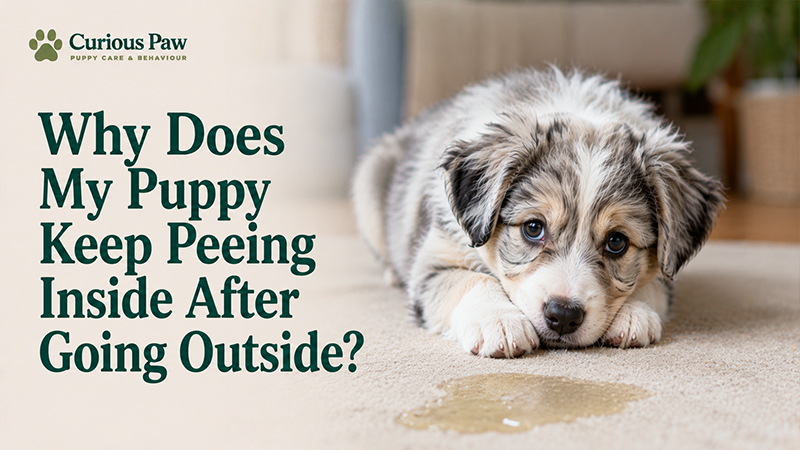
You took them out. Five minutes, maybe more. They sniffed, wandered, possibly squatted. You came back inside feeling like you’d done everything right. Then the puddle appeared anyway, right there on the kitchen floor, thirty seconds after the door closed. It feels like the puppy is doing it deliberately. They aren’t. But something in that outdoor trip almost certainly didn’t go the way you think it did.
One Squat Is Not an Empty Bladder
This is the thing most owners get wrong, and the assumption makes complete sense: the puppy went outside, therefore the puppy went. But young puppies — a 9-week-old Labrador, for instance, or any small breed under 12 weeks — rarely empty their bladder completely in a single go. They urinate in two or three bursts, often with wandering and sniffing in between. If you bring them in after the first squat, you’ve brought in a puppy with a bladder that’s half empty at best. They come inside, calm down, the stimulation drops — and whatever pressure remained suddenly gets through. The floor pays for it.
Staying outside longer is the fix, and it sounds almost insultingly simple. Not for hours — just long enough to see the puppy move away from the spot, sniff somewhere new, and seem genuinely disinterested in going again. Many owners who try this for the first time are surprised to see a second, smaller squat follow a minute or two after the first. That’s the trip actually finishing.
The Well-Meaning Mistake That Makes It Worse
Here’s the counterintuitive part: enthusiastic praise at exactly the wrong moment is a genuine cause of indoor accidents. A puppy squats outside and the owner immediately crouches down, starts clapping, delivers an excited stream of “good girl!” The puppy’s attention snaps entirely away from what their body is doing. Whatever urge remained gets suppressed by the arousal spike. Back inside, the excitement fades — and the rest of the bladder makes itself known on the rug.


Waiting until the puppy stands up and physically walks away from the spot before rewarding changes the outcome. A few extra seconds of patience at that specific moment is worth more than any amount of consistency elsewhere in the day.
The Yard Is Genuinely Overwhelming
Five minutes outside is not five minutes of focused bladder awareness. A young puppy outside is processing an enormous volume of sensory information — smells from neighboring gardens, movement at the edge of their vision, sounds from the street, the texture of the grass under their feet. The signal from the bladder that would normally prompt urination gets crowded out by everything else demanding attention. The puppy isn’t ignoring the urge. They’re genuinely not registering it clearly enough to act on it.
This is why a consistent bathroom spot matters more than most housetraining guides acknowledge. The scent from previous visits creates a kind of neurological shortcut — the puppy arrives at the familiar patch of grass, the olfactory recognition kicks in, and the behavior follows faster and more completely than it would somewhere new. Many owners notice that potty trips become noticeably quicker once they stop varying the location and go directly to the same corner every time. Boring repetition outperforms variety here by a significant margin.
Keeping the puppy on a leash during bathroom trips helps for the same reason. An unleashed puppy can wander off to investigate the fence line or follow a scent across the yard, spending the entire trip mentally occupied and never settling into the relaxed state that allows full elimination. On a leash at the same spot, the options narrow and the behavior tends to happen faster and more completely.
A Timing Problem That Rarely Gets Mentioned
The digestive system triggers a reflex to urinate roughly 5 to 15 minutes after eating or drinking. Take the puppy out 25 minutes after a meal and the outdoor trip happens just after that peak window has passed. The urge is fading when they’re outside and building again when they come back in. The accident happens on schedule. The puppy wasn’t failing to hold it — the outdoor trip was timed badly from the start.
Getting outside within 5 to 10 minutes of a meal ending tends to produce immediate improvement. It’s a small shift in timing with a disproportionate effect on how many accidents happen in the hour after feeding.
The Floor Remembers Every Accident
Repeated accidents in the same indoor spots almost always come back to scent. Uric acid crystals from previous accidents bond to flooring and survive most standard cleaning products. As humidity rises or the surface gets slightly damp, the odor releases again. To a puppy’s nose, that spot still reads as “bathroom here.” The puppy isn’t being stubborn. They’re following a signal that’s still actively there.
Vinegar, baking soda, and multi-surface sprays can mask the smell for human noses but don’t break down the compounds causing it. Enzymatic cleaners do. Applied generously, left for the full contact time on the label, and allowed to dry completely. For carpet, the cleaner needs to saturate through the pile into the backing and padding underneath — that’s where most of the odor lives, and a surface spray never reaches it. A UV black light in a dim room reveals dried urine invisible to the naked eye, including spots from previous pets or tenants that the puppy has been responding to since day one.
When It Might Be Medical
Urinary tract infections are common in young puppies — particularly females — and often the only symptom is persistent accidents that don’t respond to training. No blood, no straining, just a puppy that seems undertrained despite consistent effort. The bladder is inflamed, urgency is real, and no method overcomes a physical problem. According to VCA Animal Hospitals, a simple urinalysis identifies a UTI quickly, and a short antibiotic course typically resolves everything. If training has been genuinely consistent for several weeks without meaningful improvement, a vet check before concluding it’s behavioral makes sense.
It’s worth being honest that this problem layers. A puppy that isn’t fully emptying outside, in a house with old scent signals on the floor, whose outdoor trips happen after the peak urge window, will keep having accidents even if one of those things is addressed in isolation. Solving it sometimes means fixing two or three things at the same time.
Frequently Asked Questions
My puppy goes outside and then pees again inside 5 minutes later — why?
Most likely they didn’t fully empty outside. Puppies under 12 weeks often urinate in multiple small bursts, and if you brought them in after the first squat, there was still pressure left. Try staying outside longer and watching for a second squat before coming back in. That single change resolves this pattern for many owners within a few days.
Could it be a UTI even if my puppy seems totally fine?
Yes. UTIs in puppies often present with no obvious symptoms beyond frequent accidents that don’t respond to training. No blood, no straining, nothing that looks medically wrong. If consistent housetraining hasn’t produced improvement after a few weeks, a urinalysis at the vet is the right next step — it’s a quick test that either identifies the problem or rules it out cleanly.
I cleaned the spot but my puppy keeps going back — what am I missing?
The scent is still there. Standard cleaning products don’t break down the uric acid crystals in dog urine — they mask the smell for humans but leave a signal the puppy detects and responds to. Enzymatic cleaner eliminates the signal rather than masking it. For carpet, saturate the area so it reaches through to the padding underneath, not just the surface fibers. A UV black light in a dim room shows exactly where the residue is.
Run through it in order: stay outside longer and wait for a second squat, adjust the trip timing to within 10 minutes of meals, enzymatic clean every known spot, and if consistent handling over several weeks still produces no improvement, get a urinalysis before concluding the training has failed.
- VCA Animal Hospitals — Urinary Tract Infections in Dogs
- American Kennel Club — How to Potty Train a Puppy