
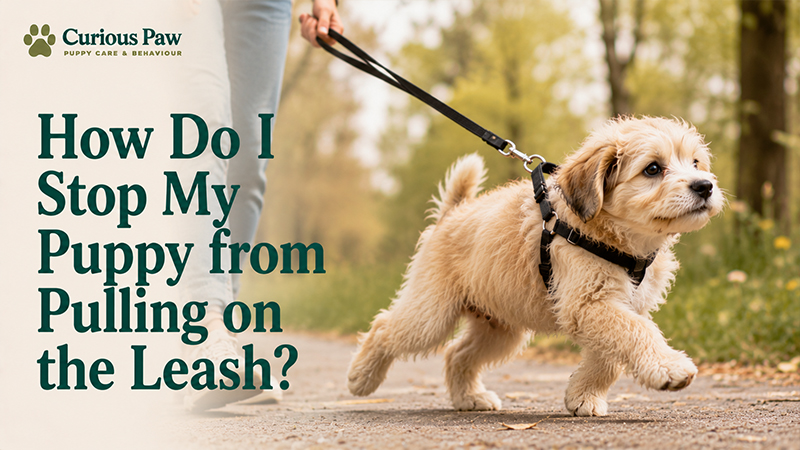
The walk that’s supposed to be relaxing ends with your arm stretched forward, the puppy straining at the end of the leash, and you arriving home wondering why you bothered. Loose leash walking is one of the more frustrating training challenges because it requires patience that’s hard to maintain in the middle of a walk when you’re also trying to actually get somewhere. The good news: most leash pulling is preventable if addressed early, before it becomes the puppy’s established understanding of what a walk is.
Why Puppies Pull
Pulling works. That’s the core of the problem. The puppy strains forward, the owner keeps walking, and the puppy reaches the interesting thing faster than they would have otherwise. From the puppy’s perspective, pulling is an effective strategy that gets consistently rewarded by forward movement. They aren’t doing it to be difficult. They’ve simply discovered that pressure on the leash produces the outcome they want.
There’s also a physiological component most owners never know about: the opposition reflex. Pressure on the front of a dog’s chest or neck triggers an instinctive push into the pressure — the same reflex that allows sled dogs to lean into a harness and pull weight. When an owner pulls back on a tight leash, they’re physically triggering a reflex that causes the dog to pull harder. Every time the leash goes tight and the owner leans back, the puppy leans forward. The harder the owner pulls, the harder the puppy pulls. Understanding this changes the entire approach — the goal is never to use the leash as a mechanism of restraint, because restraint produces more pulling.
Equipment First
Back-clip harnesses — the standard Y-shape harness that clips between the shoulder blades — actively encourage pulling because they allow the dog to put their full body weight and muscle into forward movement without any redirection. A dog wearing a back-clip harness has no mechanical disadvantage when pulling. This is why sled dogs wear them. For a puppy being trained not to pull, it’s the wrong tool.


Front-clip harnesses, which have the leash attachment at the chest, redirect the dog toward the owner when they pull rather than allowing sustained forward movement. A puppy wearing a front-clip harness and pulling forward gets turned sideways — which interrupts the pulling without any leash tension from the owner. It doesn’t replace training, but it makes the training significantly more manageable while it’s in progress. The AKC recommends flat buckle collars or front-clip harnesses for leash training; back-clip harnesses and retractable leashes actively work against loose leash training goals.
Head halters — fitting around the muzzle, not the neck — give even more control because the nose goes where the head goes, and the head goes where the owner directs. Some puppies accept them readily; others take time to get comfortable with something on their face, and the introduction should be gradual and positive before any leash walking happens in one.
The Method That Consistently Produces Results
When the leash goes tight, stop moving. Not slow down, not redirect, not tighten the leash — stop completely. No forward movement when there’s tension. The puppy pulls, the world stops moving. The puppy eases back, the leash slackens, the world starts moving again. Forward movement is what the puppy wants, and forward movement only happens on a loose leash.
This sounds simple and it is — the difficulty is applying it consistently when it means standing on the same stretch of pavement for five minutes while a puppy investigates why you’ve stopped. The first few walks with this approach often cover very little ground and require a lot of standing. That’s expected and it’s working, even when it doesn’t feel like it. Most puppies make noticeable improvement within a week if the rule is applied every time the leash tightens, by every person who walks the puppy.
A variation that helps progress: when the leash goes tight, turn and walk in the opposite direction rather than standing still. The puppy is suddenly behind you rather than ahead, the tension releases, and they follow. This keeps the walk moving and creates a stronger communication — pulling doesn’t just stop progress, it reverses it. Some puppies respond better to this than to stopping entirely.
The Realistic Expectations
Loose leash walking is one of the more complex skills to train because the environment itself — the outdoors, with its smells and sounds and movement — is constantly competing with the training. A puppy that walks beautifully in a quiet neighborhood may lose the loose leash entirely the first time a squirrel appears. That’s not regression. It’s a harder version of the same skill, and it needs to be practiced at that level too.
Build distraction gradually. Start in a low-distraction environment — a quiet street at an off-peak time, a familiar yard — and only increase the environmental complexity once the puppy is reliable in the easier setting. Taking a puppy who’s just starting loose leash training to a busy park is setting both of you up for frustration. The park is the exam, not the classroom.
The timeline for reliable loose leash walking varies significantly by puppy. High-drive breeds — working dogs, terriers, scent hounds — are generally harder to train to a loose leash because their pull toward the environment is stronger and their history of using their body against resistance is deeper in their genetics. Expectations for a Beagle and expectations for a Cavalier King Charles Spaniel on a loose leash should not be identical.
The Tool Most Owners Skip
Sniff walks — slow, puppy-led outings where the puppy is allowed to stop and investigate whatever they want for as long as they want — are one of the best ways to make loose leash training sustainable. A puppy that never gets adequate sniff time on walks is chronically under-stimulated in the way that matters most to their nervous system, and that under-stimulation produces more pulling toward everything interesting in the environment. Building regular sniff time into walks reduces the frantic urgency the puppy brings to every outing, which makes maintaining a loose leash during more structured walking significantly easier.
A well-sniffed puppy walks differently than an under-sniffed one. That difference is more noticeable after the first few deliberate sniff sessions than most owners expect.
- American Kennel Club — How to Stop Your Dog From Pulling on the Leash
- AKC — Loose Leash Walking Tips