
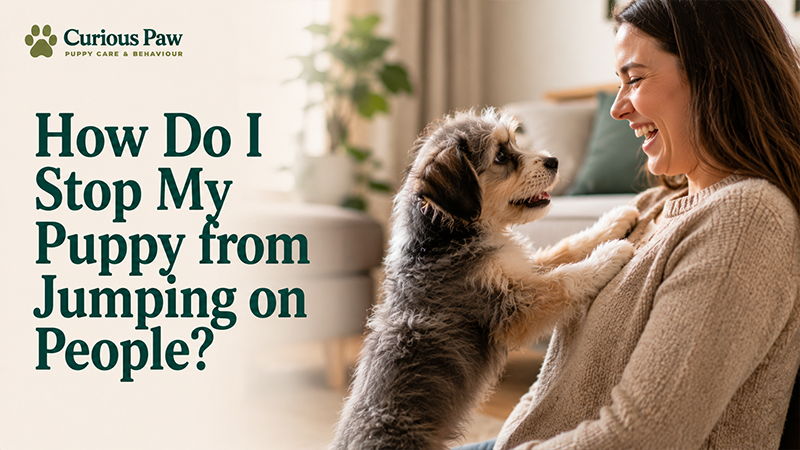
The puppy launched itself at your guest before you could do anything, your guest made the sound people make when they’re trying to be polite about it, and you spent the next two minutes apologizing and explaining that you’re working on it. The jumping isn’t aggression, and most people know that — but it’s embarrassing, it’s predictable, and a large dog doing this in 10 months is a genuinely different problem from an 8-week-old doing it now. Getting ahead of it is significantly easier than addressing it once the habit is established.
Why Puppies Jump in the First Place
Jumping is a greeting behavior. Puppies greet their mother and littermates face-to-face, and jumping up is the instinctive attempt to reach the human face they’re trying to get close to. It works — people look at the puppy, make sounds, reach down, make physical contact. According to the AKC, jumping is one of the most effectively self-reinforcing behaviors in dogs, because it reliably produces exactly what the puppy was seeking: attention, eye contact, and physical interaction. Every successful jump that produces a response teaches the puppy that jumping is the correct way to greet people.
This includes the reactions that feel like corrections. Pushing the puppy away, bringing up a knee, saying “no” firmly — all of these involve the owner’s hands and attention and often register as interaction rather than discouragement. For many puppies, being pushed away is just part of a physical game, and the knee-in-chest technique that’s commonly suggested can startle or hurt a puppy in ways that damage trust without reducing the jumping.
The Only Thing That Consistently Works
Remove the reward the instant jumping starts. All of it — eye contact, verbal reaction, physical contact, and body orientation. Turn away completely, arms crossed, no sound, complete stillness until four paws are on the floor. The moment all four feet land: turn back, engage warmly, reward immediately. The puppy is learning that jumping produces nothing and four feet on the floor produces everything they were jumping to get.


The precision of timing matters here more than the consistency of effort. A response to jumping that happens two seconds after the fact isn’t connected to the jumping. A response to four feet on the ground that happens two seconds after the feet land is connected to the sniff the puppy was doing, not the position. Mark the exact moment all four feet touch down — a clicker, a “yes,” something sharp and immediate — and reward that. With consistent timing, most puppies show improvement within a week.
Train the Alternative, Not Just the Absence
Stopping jumping is easier when the puppy has a specific, rewarded alternative to perform in greeting situations. A sit is the most practical one. A puppy that sits when a person approaches gets attention and contact as the reward for the sit — which directly competes with jumping for the same outcome. The puppy isn’t just learning “don’t jump,” they’re learning “this other thing produces what I want.”
Build the sit in low-distraction settings first. The puppy needs to understand and reliably offer the behavior before you can expect it in the middle of an exciting arrival. Then practice in progressively more stimulating scenarios: family members coming home from errands, then friends, then strangers. Each level is a new challenge — a puppy that sits perfectly for calm family member arrivals may completely lose the sit when an enthusiastic stranger arrives for the first time. That’s expected. Work up to it rather than jumping straight to the hardest scenario.
The Stranger Problem
The most consistent obstacle to training jumping is other people. The stranger on the street who says “oh it’s fine, I love puppies” and immediately bends down to engage with the jumping puppy has undone whatever training you’ve done in that moment — not permanently, but they’ve provided one of those intermittent reinforcements that makes the behavior more persistent. Every jump that produces engagement tells the puppy the behavior still works.
A practical approach: before the puppy has a chance to jump, ask the person to wait until the puppy is sitting before engaging. “She’s in training — could you wait for her to sit before saying hello?” Most people will do this if asked. If they’ve already engaged with the jumping puppy before you can redirect, that rep is gone. Intervening before the jump is possible more often when the puppy is on a leash and you can see the interaction coming. Off-leash greetings with strangers are genuinely harder to manage during the training phase.
Family members and regular visitors are where the most leverage exists. Consistent handling by everyone who interacts with the puppy regularly — every person, every time — produces faster results than perfect consistency from one person and inconsistency from others. A puppy that jumps on grandma successfully every Sunday visit learns that grandma is the exception, and exceptions keep the hope alive that the behavior might work elsewhere too.
Management While Training
During the training period, manage situations where you can’t control the response. A leash clipped to the puppy’s collar or harness before anyone comes through the door gives you the ability to prevent the jump before it happens, which prevents the puppy from rehearsing the behavior. A puppy behind a baby gate when guests arrive gives them a moment to settle before any interaction begins. Prevention of practice is part of training — every successful jump is a reinforced repetition that makes the behavior slightly more established.
The cue “off” — meaning all four paws on the floor — is useful once the puppy understands what’s being asked, but it’s not where to start. Start with the management and the reward structure, build the sit as the alternative, and add the verbal cue once the behavior is reliable enough that using the cue will actually produce the response. Using “off” before the puppy knows what it means is just noise in an already stimulating moment.
Frequently Asked Questions
My puppy only jumps on some people — why does it pick and choose?
Because some people reward it and others don’t. The puppy has learned, through experience, which people engage with the jumping and which ones don’t produce anything. Dogs are good at this discrimination. It’s actually useful information: whoever the puppy jumps on most consistently is whoever has been most reliably rewarding it, intentionally or not. Getting those specific people to change their response tends to resolve the selective jumping faster than any other intervention.
Is kneeing or pushing a puppy away a good way to stop jumping?
Rarely effective and potentially counterproductive. For many puppies, physical contact — even contact that’s meant as a correction — registers as engagement and keeps the jumping going. A knee to the chest can also hurt or startle a puppy in ways that create handling anxiety without reducing the behavior. Turning away completely and removing all engagement is consistently more effective, even though it feels less like a response to the behavior.
How long does it take to stop a puppy from jumping?
With consistent handling from everyone who interacts with the puppy, most owners see meaningful improvement within one to two weeks. Full reliability — where the puppy’s default response to greetings is four feet on the floor rather than jumping — takes longer, typically a few months of consistent practice across different contexts and with different people. The more inconsistent the handling, the longer it takes. Intermittent reinforcement of the jumping is the main thing that extends the timeline.
By five to six months, a puppy with consistent greeting training reliably offers a sit at arrivals — not because jumping has been punished out of them, but because sitting has become the behavior that reliably produces what they were jumping to get in the first place. The goal was always attention. You’ve just changed the currency.
- American Kennel Club — How to Stop Your Dog From Jumping Up on People
- American Kennel Club — Expert Tips on How to Stop a Dog From Jumping Up
- PetMD — How to Stop Your Dog From Jumping