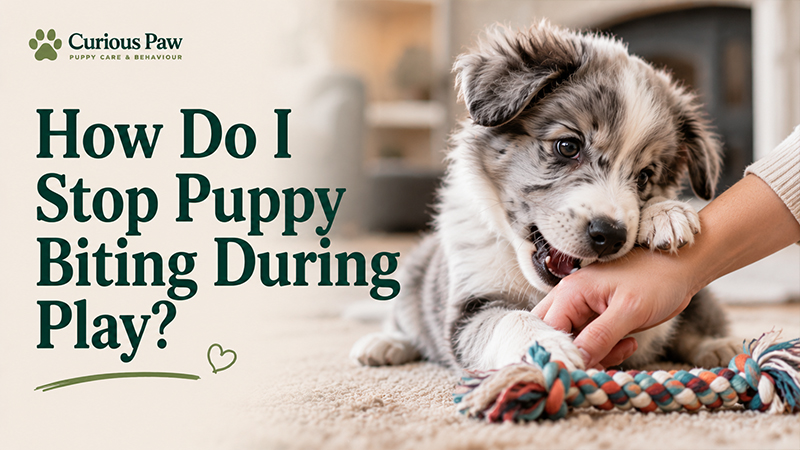
The puppy is 10 weeks old and appears to be constructed entirely of teeth. Every time play starts those teeth end up on your hands, your feet, your ankles, the sleeve of whatever you’re wearing. You’ve tried saying ouch. You’ve tried redirecting to a toy. You’ve tried ignoring it. Nothing holds for more than about 30 seconds before the teeth are back. If this is where you are, you’re in the middle of one of the most universally frustrating phases of puppy ownership — and also one of the most normal ones.
The Goal Is Not Zero Biting
Before jumping to how to stop it, it’s worth being clear about what you’re actually training toward. The goal isn’t a dog that never puts its mouth on a person. The goal is bite inhibition — the ability to control the force of the bite. According to the ASPCA, a dog that has learned bite inhibition with people doesn’t recognize human skin as something to bite hard. If that dog ever bites in a moment of fear or pain later in life — which dogs sometimes do — they use a soft mouth. A dog trained by suppressing all mouthing entirely sometimes skips the warning signals and bites with full force when scared, because the inhibition was never taught. The mouthing you’re dealing with now is the window to build that lesson.
Puppies learn bite inhibition naturally in the litter — a bite that’s too hard produces a yelp from the littermate and the game stops. You’re replicating that communication. The mechanism is: hard bite equals interaction ending immediately, not gradually, not after a few more seconds of trying to redirect.
The Yelp Method — and When It Backfires
The most common advice is to make a high-pitched yelp or “ouch” when the puppy bites too hard. It works reliably for many puppies. For others — typically the more excitable, high-drive ones — it backfires spectacularly. The sudden sound reads as exciting rather than as pain, and the puppy bites harder and faster. If you’ve tried yelping and watched your puppy ramp up rather than pause, stop doing it immediately. The method isn’t working on this particular dog and continuing produces more excitement, not less.


AKC trainer Kathy Santo recommends the alternative: turn around and tuck hands into armpits — no noise, no eye contact, complete stillness for 5 to 10 seconds. It’s quieter, less stimulating, and communicates the same message: teeth on skin ends all interaction. For puppies that escalate to the yelp, this approach is significantly more effective because there’s nothing in the response that reads as interesting.
What Consistently Works
Stop all interaction the instant teeth touch skin. No talking, no eye contact, no pushing the puppy away — any physical engagement still registers as contact and can actually reward the biting with the stimulation the puppy was seeking. Turn away, arms tucked, completely still and boring for 5 to 10 seconds. Resume. If biting happens again, repeat. If after two or three repetitions the puppy is still escalating, end the play session entirely and put the puppy in the crate to settle — not as punishment, as a reset.
Never play with bare hands. If hands are in the game, teeth end up on hands. Always have a toy available — ideally a longer one that keeps hands away from the mouth end. When the puppy redirects to the toy, that’s the behavior you’re after. Let them have it, let them win, let them feel successful. The point is getting teeth onto something appropriate, not suppressing the play drive, which is strong and healthy and not the problem.
Don’t roughhouse with your hands or feet. Wiggling fingers at the puppy, pulling a hand back quickly, allowing them to chase your feet — all of these teach the puppy that hands and feet are legitimate play targets. The rule is simple and requires consistency from everyone in the household: calm hands are not toys, moving hands invite teeth. An owner who applies this consistently while another person roughhouses with the puppy using bare hands has achieved nothing beyond confusion.
The Overtired Factor Nobody Talks About
A puppy biting harder than usual, ignoring cues it normally responds to, seemingly unable to settle — is often just overtired. Overtired puppies don’t look tired. They look like they’ve had too much coffee, as covered in the sleep article. The solution in this specific moment isn’t more redirection, it’s a crate and a nap. A genuinely unmanageable 3pm puppy frequently becomes a perfectly reasonable 3:45pm puppy after 30 minutes of sleep. Trying to train through overtired biting is frustrating for everyone and mostly ineffective — the puppy doesn’t have the impulse control available to respond to training cues it would normally follow.
Play sessions with young puppies should be short for this reason. Five to ten minutes of active engagement, then rest. Not an hour of continuous interaction that builds toward a frenzy everyone ends up frustrated by. End the session before the puppy peaks, not after.
What Makes It Worse
Pushing the puppy away or tapping their nose. Both are physical contact that reads as engagement. Yelling — even negative attention is attention, and a puppy that learns “biting produces an interesting loud reaction from the human” has learned to bite for entertainment. Inconsistency between people in the household, which teaches the puppy that the rules vary by person rather than that a rule exists. And roughhousing that involves bare hands, which directly teaches the behavior everyone then wants to undo.
The Timeline
Play biting typically peaks around 9 to 12 weeks and gradually decreases as teething progresses and impulse control develops. By 4 to 5 months with consistent handling, most puppies are noticeably softer with their mouths. By 6 to 7 months the worst of it is over — adult teeth are in and the frantic teething-driven mouthing is done. Some mouthing behavior typically remains in excited moments throughout the dog’s life. What changes is the pressure: a dog with good bite inhibition uses a soft mouth that doesn’t break skin. That outcome is built now, during these months.
Frequently Asked Questions
My puppy bites harder when I say ouch — what am I doing wrong?
Nothing is wrong — yelping just doesn’t work for all puppies. For excitable, high-drive dogs the sudden noise reads as exciting rather than painful, and they bite harder and faster in response. Stop using it and switch to the silent approach: turn away completely, tuck hands into armpits, no eye contact, complete stillness for 5 to 10 seconds. It communicates the same message with nothing in the response that the puppy finds interesting.
Is my puppy biting aggressively or is this normal play?
Normal play biting is opportunistic and stops when the interaction stops — it happens during excitement and responds to clear signals. Concerning biting looks different: stiff body posture, a fixed stare, growling that deepens rather than stops when play ends, or escalation even when you’ve completely disengaged. True aggression in young puppies is uncommon. If you’re seeing the concerning pattern consistently rather than occasionally, a vet check to rule out pain followed by a certified behaviorist assessment is the right next step.
When will my puppy stop biting so much?
The worst of it typically peaks at 9 to 12 weeks and decreases meaningfully by 4 to 5 months with consistent handling. By 6 to 7 months, when adult teeth are fully in, the frantic teething-driven mouthing is usually done. Some mouthing in excited moments stays with most dogs permanently — what changes is the pressure, not the behavior entirely. The goal is a dog that uses a soft mouth, not one that never mouths at all.
Consistent. Calm. Short sessions.
- ASPCA — Mouthing, Nipping and Biting in Puppies
- American Kennel Club — How to Stop Puppy Biting and Train Bite Inhibition