
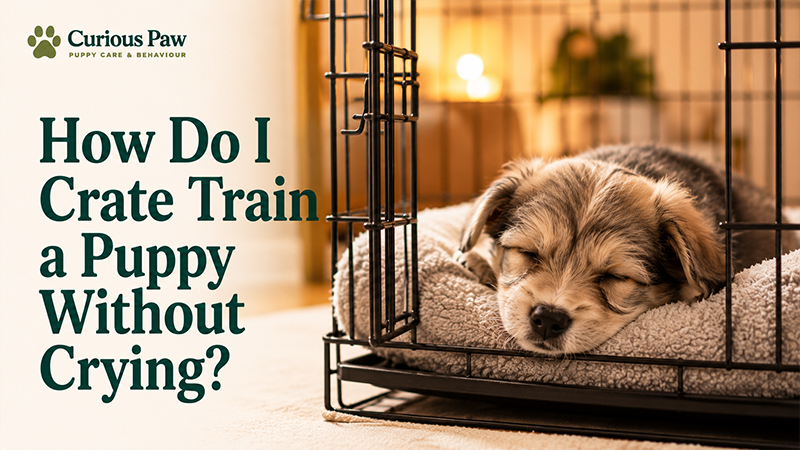
The title of this article contains a small lie — not an intentional one, but worth naming upfront. Some crying during crate training is almost unavoidable, particularly in the first few nights. The more useful question isn’t how to eliminate it entirely but how to minimize it, how to respond to it correctly, and how to build the kind of crate association that makes the crying phase short rather than endless. Most owners who say their puppy “took to the crate immediately” either had a particularly settled dog, got lucky with timing, or are misremembering the first week.
That said, a lot of the crying owners experience is directly caused by how the crate was introduced. Get the introduction right and the crying drops significantly. Rush it — and you can extend a two-week process into two months.
What You’re Actually Building
The goal isn’t a puppy that tolerates the crate. It’s a puppy that finds it genuinely comfortable — one that walks in voluntarily for naps, settles during stimulating household events, and treats it as their own space rather than a place they get put. That distinction changes how you approach the whole process. You’re not teaching confinement. You’re building an association, and that association is built through positive experiences accumulated over time, never through force, and never faster than the puppy’s individual comfort allows.
A well-crate-trained adult dog is often found sleeping in their crate with the door open. An 8-week-old Golden Retriever has no idea that’s where they’re headed. The gap between those two points is bridged entirely through patient, consistent positive experience.
Before the Door Ever Closes
The most common crate training mistake is skipping the introduction phase entirely. The puppy arrives home, the owner sets up the crate, puts the puppy in at bedtime, closes the door, and is surprised when the result is an hour of distressed crying. Of course it is. The puppy has never seen this object before, has no positive association with it, and is now locked inside it in an unfamiliar house on the first night away from their littermates. Asking a puppy to be calm in that situation without any prior preparation is genuinely unreasonable.


Spend the first one to two days letting the puppy discover the crate at their own pace. Leave it open in a room where the family spends time. Toss treats inside without asking the puppy to go in. Let them wander in and out freely. Some puppies start napping inside within a day. Others take longer — both are fine. The investigation phase is doing real work even when nothing dramatic seems to be happening.
Feeding meals inside the crate with the door open is one of the most effective early steps. Food turns the crate into a place where good things happen rather than a place where the puppy gets isolated. After a few meals, start closing the door gently while the puppy is eating, then opening it before they finish. Gradually extend the closed time over several sessions. The puppy barely notices because their attention is entirely on the food.
The Frozen Kong Detail
A Kong stuffed with a mix of kibble and plain yogurt or xylitol-free peanut butter and frozen overnight is one of the most consistently useful tools in the entire process. The puppy goes into the crate, gets the Kong, and has 20 to 40 minutes of focused licking and chewing that occupies them completely during the period when the door is first closing. A Kong frozen overnight is noticeably harder to get into than one prepared that morning, which is exactly what you want — the additional effort extends the engagement through the transition. By the time the Kong is done, many puppies have settled naturally.
Keep Kongs specifically for crate time. If the puppy gets them freely elsewhere, the crate loses its special status. The appearance of the Kong should start to predict crate time, which means the puppy begins associating the crate with something they actually want rather than something that just happens to them.
Where the Crate Lives Matters
Put the crate in the bedroom for the first few weeks. This is the recommendation from the AKC and VCA Animal Hospitals, and it’s the single change that produces the biggest reduction in nighttime crying. A puppy that can smell you and hear your breathing isn’t alone in the way that triggers genuine distress. They can confirm the pack is still present. The transition from sleeping in a pile of littermates to sleeping alone in a box in a separate room is enormous — a crate next to the bed narrows that gap meaningfully.
Covering three sides of the crate with a blanket helps. The enclosed, den-like feeling calms many puppies faster than an open wire crate in the middle of a room. Leave the front uncovered for airflow and so the puppy can see out, but reduce the visual stimulation from the rest of the room. A puppy that can see movement and light through open bars may struggle to settle; one in a covered crate often drops off within minutes.
When Crying Happens Anyway
It will. The question is what to do about it, and the advice owners encounter pulls in opposite directions. Ignore it completely, say some sources. Go immediately, say others. The reality sits in the middle and depends on what kind of crying it is.
Brief whining that starts and stops — the puppy vocalizing as they shift positions and settle — is worth waiting through. Many puppies make noise for 30 to 60 seconds and then go quiet on their own if the owner doesn’t respond. Responding to every small sound teaches the puppy that noise produces attention, which produces more noise.
Sustained, escalating distress that isn’t winding down is different. Leaving a puppy to spiral for 20 minutes builds negative associations with the crate that are harder to undo than whatever the crying was costing. If the puppy is ramping up rather than down, respond calmly — reach in, let them sniff your hand, speak quietly — but don’t take them out unless there’s a reason to. The response should communicate “you’re fine, I’m here” rather than “crying gets you out.”
Puppies under 10 weeks often need one or two nighttime bathroom trips, and early-hours crying frequently signals the bladder rather than distress. A 9-week-old can hold it for roughly two hours overnight. If it’s been two to three hours since the last trip, that’s the first thing to check. Keep the trip completely boring — no lights, no talking, outside and back in without any real interaction — or the puppy starts manufacturing reasons for the midnight outing.
Build Duration Gradually
This is where most owners go wrong in a specific, predictable way. They have a few successful sessions, conclude the crate training is working, and jump straight to a four-hour stretch. The puppy has only been comfortable for 15-minute periods. Four hours is a completely different ask, and the crying that results gets interpreted as regression when it was never real progress to begin with.
Build duration in small increments. Five minutes comfortable, then ten, then twenty, then an hour. The progression can happen relatively quickly — often within a week or two — but it has to actually happen. Skipping steps to reach the destination faster reliably produces more problems than it saves time.
Time crate sessions well. A puppy that has just eaten, played, and gone to the bathroom is in a completely different state than one that’s hungry, wound up, or overdue for a trip outside. Crating a tired, settled puppy after physical and mental activity produces calm. Crating an overtired, overstimulated one produces the opposite — and overtired puppies, as covered in the sleep article, don’t look tired.
What Not to Do
Never use the crate as punishment. A puppy sent to the crate because they chewed something or had an accident learns that the crate is where bad things happen. That association is difficult to reverse once it sets. Never force a puppy into the crate physically — lure with food, toss a treat inside, wait for voluntary entry. Forcing creates resistance that spreads to the whole training process. A puppy that backs away from the crate door every time it opens will not become comfortable through repetition of the same forced experience.
Crate training is more variable than most guides admit. Some puppies settle in days. Others take weeks. A puppy from a chaotic early environment, a pet store, or a large shelter often takes longer than one from a well-run breeder who started crate exposure early. The process is the same regardless — the timeline isn’t, and adjusting expectations to the specific puppy in front of you is more useful than following a fixed schedule.
Frequently Asked Questions
My puppy cries for hours in the crate — should I just let them cry it out?
Not for hours, no. Brief whining that winds down on its own is worth waiting through — responding to every small sound teaches the puppy that noise produces attention. But sustained distress for more than 10 to 15 minutes usually means the crate was introduced too fast, the duration was too long, or the crate is in a room that feels too isolated. Go back a step in the process rather than enduring a crying session that builds negative associations with the crate.
How long can a puppy be in the crate during the day?
One hour per month of age as a rough guideline — a 9-week-old shouldn’t be crated for more than two hours at a stretch during the day. Beyond that, the puppy physically can’t hold their bladder and the experience stops being manageable. Build toward longer durations gradually once the puppy is comfortable with shorter ones, and never extend duration faster than the puppy’s comfort warrants.
My puppy was fine in the crate and now suddenly hates it — what happened?
A few common causes: duration was extended too quickly before the positive association was solid, the crate was used as punishment at some point, or the puppy went through a fear period and the crate caught some of that anxiety. Return to basics — door open, treats tossed inside, no pressure — and rebuild the positive association before expecting the puppy to settle in it again. The reset usually takes less time than the original training.
- VCA Animal Hospitals — How to Crate Train Your Dog
- American Kennel Club — Crate Training: Step by Step