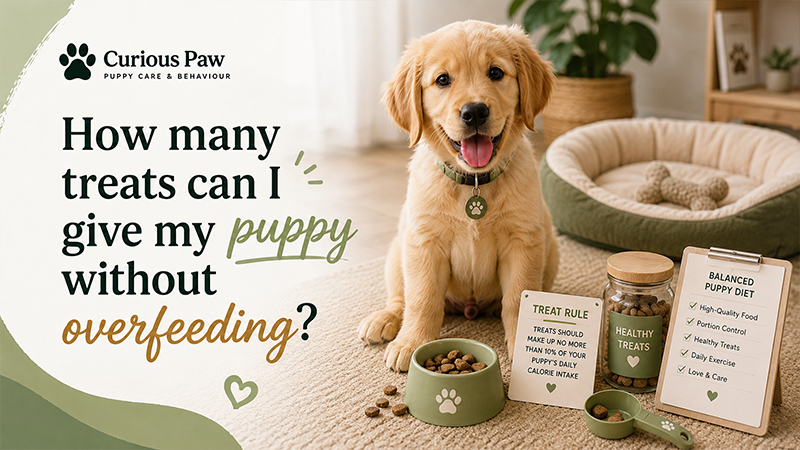
The 10 percent rule is what almost every vet and trainer gives when asked about treat limits: treats should make up no more than 10 percent of a puppy’s daily calorie intake. It sounds clear until you try to apply it. Most owners have no idea how many calories their puppy is eating daily, how many calories are in any given treat, or what 10 percent works out to in actual treat volume — which means the rule stays vague right when it needs to be practical. The math isn’t complicated. It just needs to be done once.
The Actual Math
Start with daily calorie intake. The feeding guide on the puppy food packaging gives a starting daily amount for the puppy’s weight — check the calories per cup or per can listed on the label (or on the manufacturer’s website) and multiply by how much the puppy eats per day. A 10-pound puppy eating a food with 375 calories per cup and consuming ¾ cup per day is eating about 280 calories. Ten percent of that is 28 calories available for treats.
Now look at the treat. A standard commercial dog training treat contains anywhere from 3 to 25 calories depending on size and formulation. A small soft training treat might be 3 to 5 calories. A commercial biscuit might be 20 to 40 calories. For the 10-pound puppy with 28 available treat calories per day, that works out to roughly 6 to 9 small soft treats — not the endless reward stream many owners dispense during a training session.
The Training Session Problem
Active training creates a treat math problem. A puppy working through a 15-minute training session with a responsive trainer might receive 40 to 60 treat repetitions. For a small puppy, that many commercial treats in one session can exceed its entire daily calorie allotment for treats several times over. The solution experienced trainers use isn’t giving fewer rewards — it’s using lower-calorie or zero-calorie rewards during high-volume training sessions.


The cleanest approach for training-heavy days: use a portion of the puppy’s daily kibble as the training reward rather than commercial treats. The puppy gets the same positive reinforcement experience; the calories come from the daily food allotment and are simply being delivered piece by piece rather than in a bowl. For many puppies, kibble works as a training reward with zero calorie addition to the daily total — the meal is just delivered differently.
When higher-value treats are needed for challenging environments or difficult behaviors, keeping them very small — a pea-sized piece of cheese, a fragment of chicken, a half-sized commercial treat — reduces the calorie impact while maintaining the value of the reward. The reward value to a puppy isn’t primarily about quantity; it’s about novelty and palatability. A tiny piece of real chicken is a high-value reward. The same reward as a half-inch cube is not more effective than a quarter-inch cube.
Why It Matters for Puppies Specifically
Puppies eating treat calories beyond the 10 percent threshold are displacing nutrients from their complete-and-balanced puppy food. According to Hill’s Pet, treats are generally not nutritionally complete for puppies — they fill calorie space without delivering the calcium, phosphorus, vitamins, and amino acids that a puppy’s rapid development requires. A puppy that eats a lot of treats and then skips part of its meal is getting a less nutritionally balanced diet than its food label implies. For large breed puppies specifically, where calcium and phosphorus ratios are carefully calibrated in growth formulas, treating beyond the 10 percent limit meaningfully disrupts those ratios.
Weight gain during puppyhood also has longer consequences than in adult dogs — fat cells accumulated during growth can influence body composition and metabolic rate into adulthood. The AKC notes that obesity in puppies is directly linked to joint problems, shortened lifespan, and difficulty maintaining healthy weight in adulthood. While a few extra treats don’t produce these outcomes immediately, consistent overfeeding of treats across the puppyhood period does.
Low-Calorie Treat Options
Some human foods are low enough in calories and safe enough for puppies to function as essentially free treat calories. Plain carrot sticks (about 4 calories per 1-inch piece), small pieces of apple without seeds (about 5 calories), plain cooked green beans (near zero calories), and cucumber slices are all commonly used by trainers and owners as treat extenders that allow more frequent rewards without significant calorie addition. These work particularly well as intermittent rewards between higher-value commercial treats during training sessions.
Avoid: grapes, raisins, onions, garlic, macadamia nuts, xylitol-containing products (many peanut butters), and anything with artificial sweeteners. Plain, unsalted, unseasoned single ingredients are the safe framework.
Signs You’re Overdoing It
The puppy consistently leaving part of its meal uneaten. Visible weight gain in the weeks between vet visits. Loose stools without a change in food (high-fat treats can trigger digestive upset). Treats becoming ineffective as rewards because the puppy is never hungry enough to be motivated. That last sign — the puppy that works brilliantly for treats before meals and barely responds to them an hour after a treat-heavy training session — is the most practical indicator that treat volume is too high.
On training-heavy days, reserve a portion of the daily kibble at the start of the day for use as training rewards, reduce commercial treats accordingly, and account for anything high-value by making the daily meal slightly smaller. The 10 percent rule applied consistently prevents the slow calorie creep that most owners don’t notice until the puppy is noticeably heavier than it should be.