
A small number of common foods are genuinely dangerous to dogs, and they need to be established clearly before any list of what’s safe. Grapes and raisins top that list — not because of a toxicity threshold, but because there is no established safe dose. One grape has caused acute kidney failure in some dogs while other dogs ate larger amounts without apparent harm. The unpredictability is the danger. The ASPCA Animal Poison Control Center identifies grapes and raisins as one of the most commonly involved foods in serious dog poisonings. They go in the category of never, not occasionally, regardless of how small the amount seems.
Foods to Never Give
Grapes and raisins — acute kidney failure, no established safe dose, avoid entirely. Onions, garlic, leeks, and chives — Allium family vegetables that damage red blood cells and can cause hemolytic anemia; toxic whether raw, cooked, or powdered; effects can be delayed several days after ingestion. Avocado — the flesh contains persin in amounts that cause vomiting and diarrhea in dogs; the pit is a choking and obstruction hazard; avoid the plant entirely. Cherries — the pit, stem, and leaves contain cyanide; the flesh alone is technically safe but the preparation risk makes them not worth it. Wild mushrooms — store-bought culinary mushrooms are generally safe, wild ones are not; the risk of misidentification is high enough that mushrooms are better avoided entirely as a default. Tomato plant (leaves and green fruit) — contain solanine; ripe tomato flesh in small amounts is likely fine but not worth the confusion, particularly if the puppy has garden access.
Vegetables Puppies Can Eat
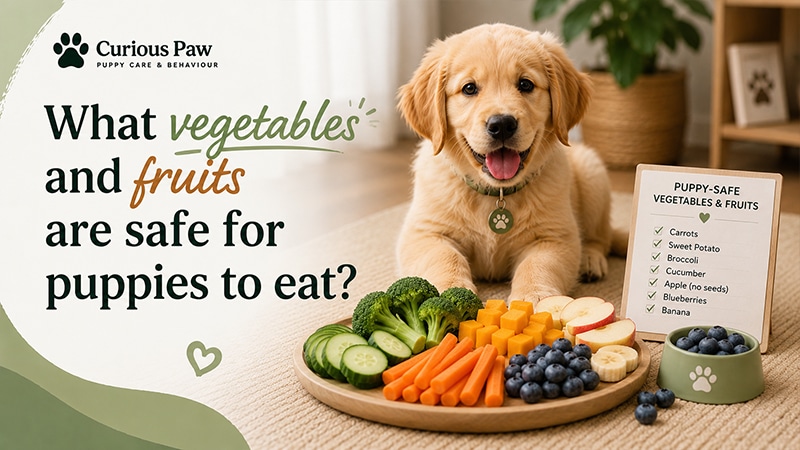
Carrots are among the most practical options — low calorie, crunchy, good for chewing engagement, and safe raw or lightly cooked. Baby carrots work as-is; larger carrots should be cut to prevent choking. A frozen carrot is also useful during teething for the combination of cold relief and chewing engagement. Green beans — plain, unseasoned, and either raw or steamed — are near-zero calorie and can be used as treat extenders during training without adding meaningful calorie load. Broccoli is safe in small amounts; the florets are fine but the stalk can be a choking hazard for small puppies and should be cut small. Broccoli in large quantities can cause gastrointestinal distress, so small pieces as occasional treats rather than regular additions.


Cucumbers are very low calorie, high water content, and well-tolerated by most dogs — useful for puppies watching calorie intake or as a hydrating summer treat. Peas — fresh or frozen, not canned (too much sodium) — are fine and contain some protein. Worth noting: peas are under investigation in connection with the grain-free/DCM issue when they’re a primary ingredient in commercial food; as an occasional treat they’re a different scenario entirely. Sweet potato cooked and plain (not raw, not seasoned) is nutritious and well-tolerated; raw sweet potato is harder to digest and should be avoided. Spinach in small amounts is safe, though its oxalic acid content makes large regular quantities inadvisable for dogs with any tendency toward kidney stones.
Celery is safe and low calorie; the strings can be a texture issue for small puppies and it’s worth cutting into smaller pieces. Brussels sprouts are safe but produce gas in many dogs — fine as an occasional treat if the owner doesn’t mind the consequence. Pumpkin — plain cooked or canned pumpkin, not pie filling — is beneficial for digestive health and commonly recommended by vets for mild diarrhea or constipation. A tablespoon or two per day is the typical amount for small puppies.
Fruits Puppies Can Eat
Blueberries are one of the better fruit options — antioxidant-rich, small enough to not be a choking hazard, and palatable to most dogs. They work well as training treats and are appropriately low in calories. Watermelon without seeds or rind is high water content and low calorie — the rind can cause GI upset and the seeds are a choking risk in small puppies, so prep matters. Apples without seeds or core are safe and a good source of fiber and vitamin C; the seeds contain trace cyanide and should always be removed. Sliced, not whole.
Bananas are safe but higher in sugar and calorie density than most other fruit options — appropriate as an occasional treat, not a regular daily one. Strawberries are safe and contain vitamin C; again, higher in sugar than vegetables, so moderate use. Pears without seeds or core — the seeds contain trace cyanide. Mango without pit — the pit is a choking and obstruction hazard and contains trace cyanide. Pineapple without skin, core, or leaves is safe and contains bromelain, an enzyme that aids protein digestion. Cantaloupe without rind and seeds. Raspberries — safe but contain small amounts of xylitol naturally; fine in small quantities (a few berries), not in large amounts.
Always remove pits, seeds, and cores from any fruit — most contain trace cyanide. Remove rinds where noted. Plain and unseasoned means no salt, sugar, butter, garlic, onion powder, or any seasoning — the human-prepared version of many vegetables is not the same as the plain version that’s safe for dogs. Introduce any new food in small amounts first to check for individual digestive sensitivity. And treat volume should still fall within the 10 percent daily calorie guideline regardless of how nutritious the food is.
The dangerous list is short and memorizable: grapes and raisins, the Allium family (onions, garlic, chives, leeks), avocado, cherry pits and stems. Most common produce is fine in moderate amounts with basic preparation. When in doubt about a specific food, the ASPCA Animal Poison Control website has a searchable database, and a quick vet call is always appropriate before introducing something new regularly.
- ASPCA — People Foods to Avoid Feeding Your Pets
- American Kennel Club — Fruits and Vegetables Dogs Can or Can’t Eat
- WebMD — What Are Safe Fruits for Dogs to Eat?