
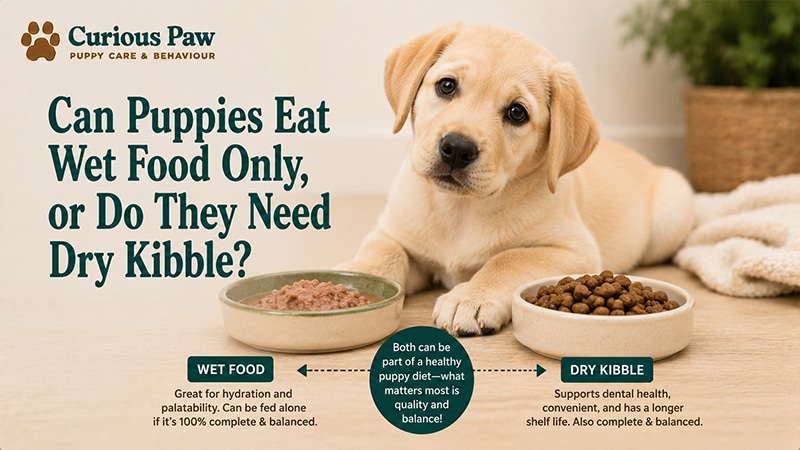
Dry kibble is not a nutritional requirement. A puppy eating exclusively wet food that carries the AAFCO complete and balanced statement for the growth life stage is getting the nutrients it needs. The Merck Veterinary Manual confirms that wet and dry commercial dog foods provide equivalent nutrition when both are properly formulated. The choice between wet food only, dry food only, or a combination comes down to practical considerations — the puppy’s preferences, the owner’s budget and convenience, dental health, and hydration — rather than one being nutritionally superior to the other.
What Wet Food Does Better
Wet food is significantly higher in moisture — typically 70 to 80 percent water, compared to around 10 percent in dry kibble. For puppies that are reluctant water drinkers or that need additional hydration for health reasons, wet food contributes meaningfully to daily fluid intake. The higher moisture content also makes it more palatable for most dogs — wet food’s smell and texture are considerably more appealing than dry kibble, which is why picky eaters and small breed puppies that can be difficult to get eating often do better on wet food.
During the teething phase — roughly 12 weeks to 6 months — wet food is easier to eat when gum soreness makes hard kibble uncomfortable. Many owners temporarily switch to wet food or soften kibble with water during peak teething discomfort, then return to dry when the worst has passed. Wet food is also easier to transition very young puppies onto when they’re first weaning from mother’s milk — its soft texture bridges the gap from nursing to solid food in a way dry kibble doesn’t.
What Dry Kibble Does Better
Cost and convenience are the main practical advantages of dry food. Kibble is significantly less expensive per calorie than wet food — a consideration that adds up over the months and years of a dog’s life. It stores easily without refrigeration once opened (for several weeks in an airtight container), doesn’t spoil within hours, and is easy to measure consistently. Wet food opened and not finished needs refrigeration and should be used within two to three days.


The dental benefit of dry kibble is real but modest. The mechanical action of chewing hard kibble removes some surface plaque — but not from the gumline, where periodontal disease originates, and not from between teeth. It’s better than nothing and worse than brushing. Owners relying on dry kibble as their primary dental health tool should know that it doesn’t replace brushing, but it does contribute something wet food doesn’t.
Kibble also works better with food puzzles, slow feeders, and Kong-style enrichment toys. Using a portion of the daily food ration in enrichment feeding is one of the more effective ways to add mental stimulation to a puppy’s day. Wet food can be used in frozen Kongs effectively, but it doesn’t work in most dry puzzle feeders.
The Wet-Food Pickiness Trap
One practical risk of feeding exclusively wet food from the start is that it can create a puppy that refuses to eat dry food if circumstances require a switch — travel, cost changes, a recalled formula, or a vet recommendation to switch formats. The palatability gap between wet and dry food is significant. A puppy that has only ever eaten wet food may genuinely refuse dry kibble for long enough that owners give in, reinforcing the refusal. Getting a puppy comfortable with both formats early — even by occasionally mixing them — prevents this from becoming a problem later.
This isn’t an argument for dry food over wet food. It’s a note about flexibility. A puppy that accepts both, or that can be transitioned between them in a gradual 7 to 10 day switch, is more adaptable than one that has only ever known wet food and treats kibble as something foreign.
Mixing Both
Mixed feeding — wet food as a topper on kibble, or a portion of each at mealtimes — gives owners some of the benefits of both formats. The wet food improves palatability and adds moisture; the kibble contributes to dental mechanics, cost management, and enrichment compatibility. The key practical note when mixing: total daily calories from both sources combined should match the puppy’s requirement, not the full daily amount from each source separately. Wet food used as a topper should replace some of the kibble portion, not be added on top of a full kibble meal.
The format — wet, dry, or mixed — matters less than what’s in the food. An AAFCO-certified formula for the growth life stage, fed in the right quantity for the puppy’s size and stage, from a named protein source, is the standard that applies regardless of whether it comes in a can or a bag.