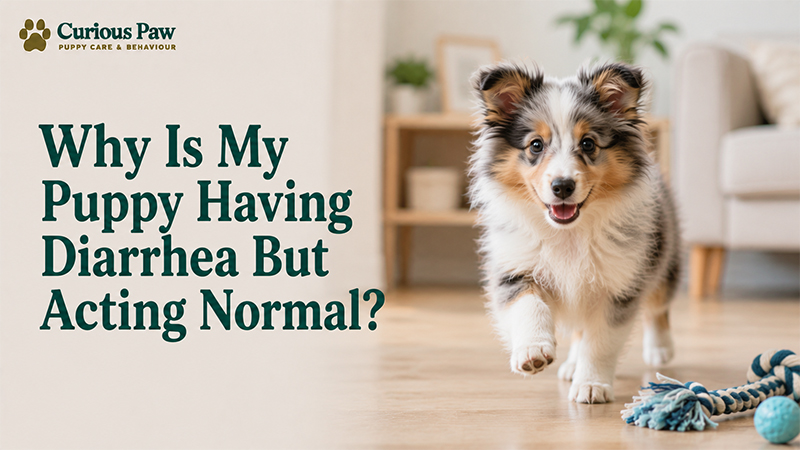
A puppy that has loose stools but is otherwise bouncy, eating well, and showing zero signs of distress is a common and usually manageable situation. Acting normal is a genuinely useful signal — it tells you the puppy’s system isn’t in crisis — but it doesn’t mean the diarrhea itself is something to wait out indefinitely. Puppies dehydrate faster than adult dogs, and what starts as a mild digestive disruption can shift into a more serious situation without obvious warning. The cause matters, and some causes need a vet even when the puppy seems fine.
The Most Common Causes
Dietary disruption is the most frequent explanation. A sudden food change, a new treat, something picked up off the ground during a walk, eating grass, getting into the trash, or being fed table scraps — any of these can produce 24 to 48 hours of loose stools in an otherwise healthy puppy. Puppies’ digestive systems are more sensitive than adult dogs’ and react to novelty readily. The diarrhea that follows a clear dietary event and resolves within a day or two, in a puppy that’s eating and acting normally, is usually manageable at home with a call to the vet to confirm the approach.
Intestinal parasites are extremely common in puppies, and here’s what most owners don’t expect: a puppy with a significant parasite load can appear completely normal in energy, appetite, and behavior. The diarrhea — sometimes watery, sometimes mucus-streaked, sometimes intermittent — is often the only external sign that parasites are present. Roundworms, hookworms, giardia, and coccidia are all common in puppies regardless of their apparent health status. A fecal test from the vet identifies what’s present and what treatment is needed. This is one situation where the puppy acting normal is genuinely misleading.
Stress causes gastrointestinal upset in puppies with an inconsistency that can be confusing — a puppy that seemed to settle into a new home fine will sometimes start having loose stools several days in as the stress response catches up. Travel, a new person in the house, a change in schedule, or any significant environmental shift can produce temporary digestive disruption without the puppy showing obvious behavioral signs of stress.
Recent vaccination can cause mild gastrointestinal symptoms including loose stools for 24 to 48 hours as the immune system responds. Expected, self-resolving, not a reason to withhold future vaccines.
What to Do at Home
For mild diarrhea in a puppy that’s acting normally, eating, and drinking: make sure water is always accessible, monitor closely, and call the vet rather than waiting to see if it resolves. VCA recommends against the old “withhold food for 24 hours” approach for puppies — unlike adult dogs, puppies can’t safely go without food for that long, and for small breeds or puppies under 12 weeks, the risk of hypoglycemia from fasting makes it genuinely dangerous.

A temporary switch to a bland diet — plain boiled chicken and plain white rice in a roughly 1:3 ratio — reduces the digestive load while the gut recovers. This is appropriate as a short-term measure for diet-triggered diarrhea, not as a permanent approach or a substitute for addressing an underlying cause like parasites or infection. Probiotics designed for dogs can support gut microbiome recovery during and after a diarrhea episode; the specific formulation matters, and a vet can recommend one appropriate for puppies.
Blood in the stool — either bright red or dark and tarry · Diarrhea accompanied by vomiting · Diarrhea that’s very frequent or watery without improvement after 24 hours · Any lethargy, loss of appetite, or visible distress alongside the diarrhea · Diarrhea in an unvaccinated or incompletely vaccinated puppy · Diarrhea in a puppy under 12 weeks · Signs of dehydration: dry or tacky gums, slow skin return when pinched at the back of the neck, sunken eyes
For puppies over 4 months who are acting completely normally, eating and drinking well, and have no blood in the stool, PetMD notes that waiting up to 24 hours before a vet visit may be reasonable — but a phone call to the vet is still appropriate to confirm this.
On Bloody Diarrhea
Blood in a puppy’s stool is alarming and worth a vet call every time, but it’s not always the emergency it looks like. A small amount of bright red blood in soft stool — often from mild colonic inflammation or straining — is different from large amounts of dark, digested blood or hemorrhagic diarrhea, which is a genuine emergency. According to PetMD, a slight amount of bright red blood in an otherwise normally active puppy who is eating and drinking is worth calling about but not always a reason to rush to an emergency clinic. Any amount of dark, tarry, or significant blood, or any blood alongside lethargy or vomiting, means go to the vet immediately.
The Parvo Consideration
In any unvaccinated or incompletely vaccinated puppy with diarrhea — even a puppy that’s currently acting normally — parvovirus needs to be on the list of things to rule out. Parvo can present with what looks like ordinary GI upset in the early hours before the full clinical picture develops. A puppy that’s “just” having diarrhea without other symptoms today can be critically ill tomorrow if parvo is the cause. The AKC specifically recommends calling the vet any time an unvaccinated puppy has diarrhea, regardless of how otherwise normal the puppy seems.
Frequently Asked Questions
My puppy has diarrhea but is playing and eating fine — do I need to go to the vet?
Call your vet to discuss it, even if you don’t go in immediately. For puppies over 4 months with no blood in the stool, no vomiting, and completely normal energy and appetite, a brief wait-and-monitor approach may be appropriate — your vet can advise. For puppies under 4 months, for unvaccinated or incompletely vaccinated puppies, or if there’s any blood or other symptoms, a vet visit rather than just a call is the right move. Diarrhea in puppies can escalate to dehydration faster than in adult dogs.
Could my puppy have parasites even though they seem healthy?
Yes, reliably. Puppies frequently have significant intestinal parasite burdens — roundworms, hookworms, giardia, coccidia — without showing obvious signs of illness. The diarrhea, which may be intermittent or mucus-streaked, is often the first and only visible sign. A fecal test at the vet is the only way to confirm what’s present and what treatment is needed. This test is recommended at every puppy wellness visit for this reason.
Should I withhold food from my puppy when they have diarrhea?
No — the old approach of fasting for 24 hours is no longer recommended for puppies. Puppies can’t safely go without food for that long, and small breeds or puppies under 12 weeks risk hypoglycemia from fasting. Instead, offer small, frequent portions of a bland diet — plain boiled chicken and plain rice — to reduce digestive load while keeping the puppy fed. Confirm this approach with your vet, particularly for very young puppies.
Acting normal is reassuring. It’s not a reason to skip the vet call.