
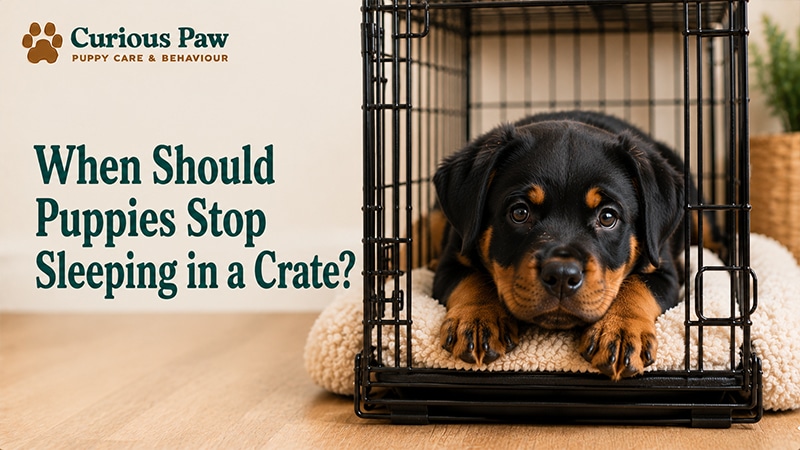
There’s no age at which a puppy “should” stop sleeping in a crate, and treating the crate as something to graduate out of as quickly as possible misses the point. The crate stops being necessary when the specific dog has demonstrated the reliability that makes overnight freedom appropriate — reliable housetraining, no destructive behavior when unsupervised, and a stable enough settling that it can sleep through the night without supervision. That might happen at 6 months. It might not happen until 18 months. The dog’s demonstrated behavior, not a calendar date, is the right indicator.
What Readiness Actually Looks Like
Reliable housetraining. The dog hasn’t had an indoor accident in at least several weeks, including during periods without direct supervision. Not “mostly reliable” — consistently reliable. Accidents during crated overnight sleeping and accidents during free overnight sleeping are very different, because the crate mechanism works on the dog’s instinct not to soil its sleeping space. A dog that hasn’t yet generalized that instinct to the whole house will use a corner of the room at 2am if given the option.
No destructive behavior when unsupervised during the day. If the dog chews furniture, raids counters, or creates destruction during daytime unsupervised periods, overnight free-roaming is premature. The same impulses that drive daytime destruction don’t disappear at night. A dog that’s trustworthy during the day, in a similar unsupervised scenario, has demonstrated the impulse control that makes overnight freedom reasonable.
Settles independently. A dog that can be in the room with you asleep for a few hours without attention-seeking, crying, or demanding engagement is likely to do the same overnight. A dog that’s been crated for overnight precisely because free roaming means immediate disruption for the household isn’t ready to trade the crate for freedom just because it’s older.
The Gradual Approach
Moving from crate to full overnight freedom in one step is the approach most likely to fail and produce a reset to crating indefinitely. A gradual transition that doesn’t take an all-or-nothing approach produces better results: the dog doesn’t have to go from always crating to completely free — it can try a larger area first and progress from there.


A more reliable approach: start with the crate door open at night, in the same room. The dog can leave if it wants to, but the familiar space is available. Then move to a baby-gated single room — bedroom, living room, whatever is the most neutral option for that household. Observe what actually happens. A dog that stays on its bed, doesn’t have accidents, and doesn’t destroy anything has demonstrated readiness for a slightly larger area. A dog that immediately investigates the trash, has an accident by the door, or wakes the household hasn’t.
Each expansion should be tested during a period when the owner is home and able to hear what’s happening, not on the first overnight trip away from home. Leave the dog with more freedom during a weeknight when you’re there to assess, not on a vacation when you can’t observe the outcome.
Typical Timeline
Most dogs are ready to be left outside a crate somewhere between 6 and 18 months. Dogs that are mouthy, chew-prone, or in active adolescence tend toward the longer end. Small breeds that complete their development faster often reach reliability sooner. High-drive breeds and those prone to destruction or counter-surfing often need the full range. The variation is real enough that any specific number is more a rough guide than a prediction.
The secondary chewing phase at 8 to 10 months — when adult teeth settle into the jaw — is worth factoring in. A dog that seemed trustworthy at 7 months may start chewing again at 9 months as the jaw changes. Building some buffer around this window rather than transitioning right before it reduces the likelihood of backtracking.
The Case for Keeping the Crate Available
A dog that was crate-trained well and found the crate comfortable often continues to use it voluntarily. The crate door can be left open permanently, making it a chosen sleeping or resting spot rather than required confinement. A dog that gravitates to its crate for naps, settles there during stimulating household events, or goes there when it needs quiet has found the crate useful for reasons unrelated to overnight management.
Keeping the crate available long-term also means it’s available when needed: travel, veterinary recovery, illness, any situation where the dog needs a familiar, controlled space. A dog that has always had positive associations with a crate is far easier to crate in an emergency or a new environment than one who experienced it only as a puppy restriction and has no current relationship with it.
Many owners who transition their dogs out of overnight crating keep the crate in the bedroom with the door open indefinitely. The dog that chose freedom for a few months and then started sleeping in its open crate again is doing exactly what a well-crate-trained dog does — treating it as its own space rather than a place it was put.