
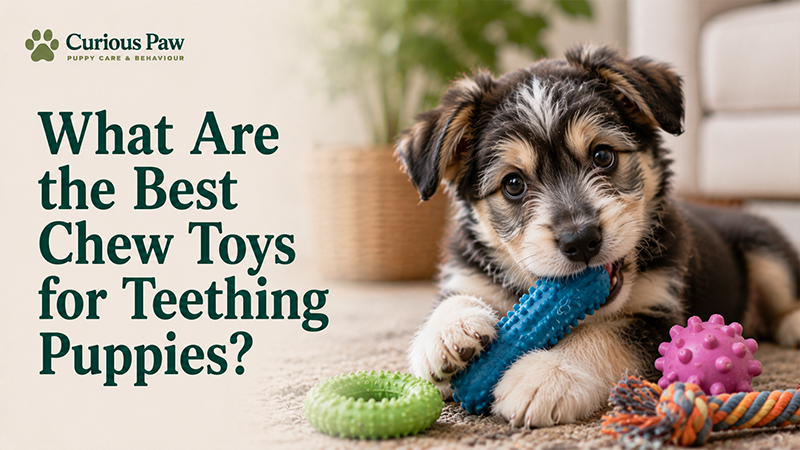
You came home to a shoe. Or a chair leg. Or the corner of a doorframe that’s going to bother you for months. The puppy looks approximately zero percent sorry, because from their perspective they’ve just done 45 minutes of entirely satisfying work. The problem isn’t the chewing. Chewing is unavoidable and developmentally important during the teething phase. The problem is having nothing better available than your furniture.
When Teething Actually Happens
Puppies are born toothless, develop 28 baby teeth by around six weeks, and then start losing them from about 12 to 13 weeks onward as 42 adult teeth push through. The full teething process wraps up somewhere between six and seven months for most puppies, with the adult molars coming in last. The most uncomfortable window is roughly 3 to 6 months, when baby teeth are loosening and adult teeth are erupting through inflamed gum tissue at the same time.
During this period chewing isn’t a behavior problem — it’s the puppy’s primary mechanism for relieving gum discomfort. Trying to stop it entirely is both impossible and counterproductive. The goal is to redirect it toward something appropriate rather than toward something it can’t have.
What Makes a Chew Toy Safe for Teething Teeth
The most practical test any owner can use before giving a puppy a new chew toy: press your thumbnail firmly into the material. If it leaves no mark, the toy is too hard. Baby teeth and newly erupted adult teeth are more vulnerable than mature teeth, and a toy harder than the tooth itself can crack or fracture them — which means veterinary intervention under anesthesia. Antlers, real bones, hard nylon, and very dense rubber all fail this test for teething puppies. They might be fine later. They’re not fine now.


Size matters as much as hardness. A toy that fits completely in the puppy’s mouth is a choking hazard. Go slightly larger than seems necessary and account for how fast puppies grow — a toy that’s appropriately sized at 10 weeks may be too small by 16.
What Actually Works
The Kong Classic in its puppy-specific version — made from softer red rubber rather than the stiffer black rubber of the adult versions — is the consistent recommendation from vets and trainers for a reason that goes beyond durability. It passes the thumbnail test easily, it doesn’t shed material, it can be stuffed with food to extend the engagement significantly, and it can be frozen. A Kong packed with a mix of kibble and plain yogurt and frozen overnight is harder to get into than one prepared that morning, which is precisely what makes it useful — the effort is what occupies a teething puppy for 20 to 40 minutes instead of 5. Worth keeping a rotation of two or three in the freezer during the worst of the teething months.
West Paw’s Zogoflex is worth knowing as a Kong alternative — similar concept, different shape, dishwasher safe, and guaranteed against destruction. Some puppies that go through Kongs quickly do better with this one.
Nylabone makes puppy-specific teething toys in a softer formulation than their adult products — the key distinction matters, because the adult Nylabone range is too hard for teething teeth. The puppy versions have raised nubs that massage gum tissue during chewing, which genuinely helps with the discomfort of eruption. PetMD notes this texture specifically for its soothing effect on inflamed gums.
Cold relieves inflamed tissue, which is why frozen options are worth having during the worst weeks. A wet washcloth twisted and frozen is a free and effective option. Frozen baby carrots work for puppies that tolerate them. Purina recommends avoiding ice cubes directly because they’re too hard and can be swallowed whole.
Bully sticks — supervised — are one of the better natural chew options for puppies from around 3 to 4 months. They’re digestible, they don’t splinter, and most puppies find them highly motivating. The caveats: they need to be size-appropriate, never left unsupervised, and taken away before they get short enough to swallow whole. Bully stick holders — small rubber or silicone grips that keep the last piece from being gulped — are useful and cheap.
What Not to Give
Rawhide is the most commonly given chew that most vets would prefer owners skipped entirely. It softens with chewing and breaks off in irregular chunks that are difficult to digest and a genuine choking and obstruction risk. There are better options that don’t carry this downside.
Cooked bones of any kind splinter. The fragments are sharp enough to puncture the esophagus, stomach, or intestine. This includes chicken bones, pork bones, beef bones from cooked meals — any bone that has been heated. Rope toys work fine as interactive tug toys with supervision, but left alone with a determined chewer, the fibers unravel, become strings, and cause intestinal damage when swallowed. Adult dog chew toys marketed for aggressive chewers are typically too hard and too dense for the specific vulnerability of a teething puppy’s teeth.
After Teething
The teething phase ends around six to seven months. The chewing doesn’t. Dogs chew throughout their lives for mental stimulation, stress relief, and because it feels good. The toy requirements shift as adult teeth are fully hardened — harder options become appropriate that weren’t before — but the need for appropriate chew outlets remains. Rotating toys so the puppy doesn’t lose interest in a Kong they’ve had for three weeks is worth doing throughout puppyhood and beyond. The same toy every day stops being interesting. Cycling through a small selection keeps the engagement up without requiring an endless supply of new purchases.
- PetMD — Puppy Teething Toys: Pick the Best Chew Toys for Puppies
- Bayshore Veterinary Hospital — Safe Toys for Teething Puppies