
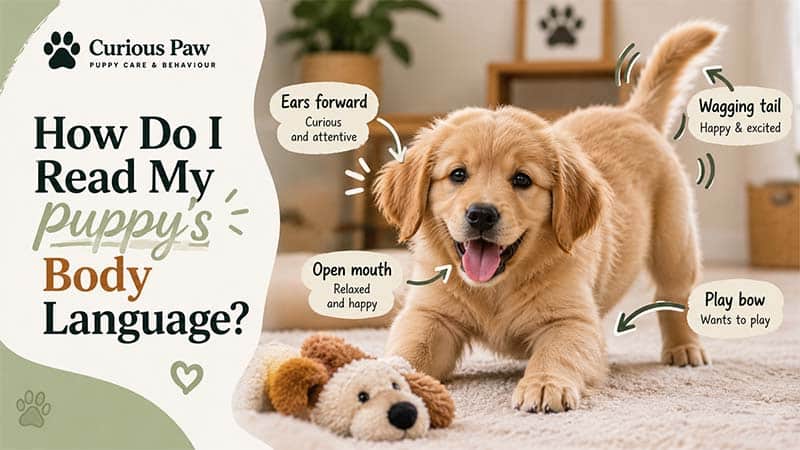
Dogs communicate almost entirely through body language, and a puppy that bites, shies away, or snaps is always communicating something specific before it acts. Learning to read those signals accurately is one of the most practical skills a puppy owner can develop, because it changes the quality of every interaction: it makes training more effective, prevents unnecessary conflict, and allows the owner to intervene before a situation escalates rather than after.
What a Relaxed, Happy Puppy Looks Like
A puppy in a positive, comfortable emotional state shows loose, fluid body movement without tension. According to the ASPCA’s canine body language resources, key signals include: muscles soft rather than held; tail in a neutral or gently wagging position; ears neither pinned flat nor rigidly forward; soft, blinking eyes rather than a hard stare; and readiness to approach and engage rather than avoid. The relaxed puppy’s body language has a quality that is easy to recognize once you know what to look for: it moves freely, without holding itself together against any imagined threat.
Stress and Displacement Signals
Stress signals in dogs include behaviors that are easily mistaken for randomness or irrelevance: lip licking when food is not present, yawning when not tired, turning the head away during an approach, shaking off as if wet when dry, and sniffing the ground during an otherwise engaged interaction. These are displacement behaviors that signal the dog is experiencing low-level stress about the current situation. When a puppy lip-licks as you reach toward it, or yawns when you make direct eye contact, it is communicating discomfort rather than performing a random behavior. Recognizing these early signals allows intervention before they escalate to clearer avoidance or defensive responses.
Fear and Defensive Signals
More obvious fear signals include: ears pinned flat against the head; tail tucked between the legs; crouched, lowered body posture; leaning or moving away from the trigger; whale eye (the whites of the eyes visible as the dog turns away while keeping the trigger in view); and panting or trembling not associated with heat or exercise. A puppy showing these signals is in a defensive, conflict-avoiding state. Forcing interaction on a puppy showing clear fear signals teaches it that its communication is ineffective, which is how dogs learn to skip the warning signals and go directly to defensive biting.
Arousal and Alert Signals
Arousal signals indicate heightened emotional activation that is not necessarily positive or negative but that warrants attention: weight shifted forward, ears forward and oriented toward a stimulus, tail held high (not necessarily wagging), pupils dilated, and a focused or fixed gaze. A high-arousal puppy that is alert to something may be excited and friendly, or may be building toward a reactive or defensive response. Reading the arousal signals alongside the rest of the body (forward-leaning with loose body and soft eyes is very different from forward-leaning with tense body and hard stare) determines which direction the emotional state is pointing.
Frequently Asked Questions
My puppy growls when I pet it sometimes. What does that mean?
Growling is a communication signal, not a behavior to suppress. A puppy that growls when touched in a specific location or at a specific time is communicating that it is uncomfortable with that interaction. The appropriate response is to stop the interaction that produced the growl and investigate the cause: is the puppy in pain at the location being touched, is it resource guarding something, or is it reaching a tolerance threshold for the type or duration of handling? Never punish a growl, as doing so suppresses the warning signal without addressing the underlying discomfort, and a dog that no longer growls before biting is more dangerous, not better behaved.
How do I know if my puppy’s tail wag means it’s happy?
Tail wagging indicates arousal and emotional activation, not exclusively happiness. The position and quality of the wag matter: a loose, wide, low-to-mid tail wag involving the whole rear of the dog is associated with positive arousal. A stiff, high, rapid wag with small amplitude is associated with alert or tense arousal. A tucked tail that still wags is associated with anxiety or conflict. Read the wag alongside the rest of the body rather than treating it as a standalone indicator of friendliness.
My puppy shows none of these stress signals but still bites. Why?
Not all biting in puppies is stress or fear-related. Mouthing and biting during play and exploration are developmentally normal and not associated with the stress signals described here. A puppy biting during play in a loose, playful state is in the bite inhibition learning phase, not in distress. Distinguishing play biting (loose body, responsive to feedback) from defensive or overstimulation-related biting (tense body, unresponsive to feedback) helps determine the appropriate response to each context.
