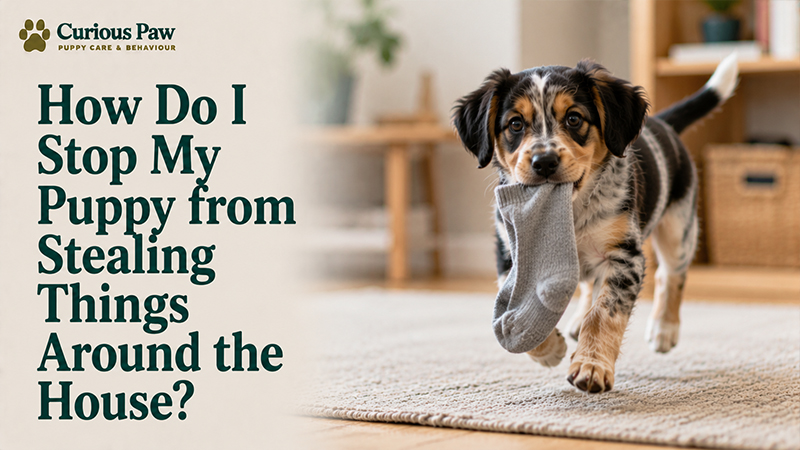
The puppy has the TV remote. You move toward them to retrieve it. They back up, tail going, eyes bright with anticipation. You reach for it. They dart sideways. You pursue. They take off around the couch. This is now the best game in the house, and every time you play it you make the next round more likely.
Why Stealing Gets Worse the More You React
The puppy that steals household objects and runs is almost always not seeking the object itself — they’re seeking the interaction the object produces. A sock on its own is mildly interesting. A sock that makes the owner drop everything, make animated noises, and chase them around the living room is one of the most exciting things that’s ever happened. According to the AKC, chasing a puppy to retrieve a stolen item teaches the puppy that stealing triggers the most engaging human behavior available. The lesson is reliable and gets reinforced every time the owner responds with pursuit.
This is why stealing tends to escalate rather than resolve on its own. The puppy grabs a shoe, the owner chases and retrieves it. The puppy learns to grab shoes more reliably. The owner chases more frequently. The behavior is on a consistent reinforcement schedule, and consistent reinforcement is the most effective way to strengthen any behavior.
Prevention Is the First Intervention
The most effective response to stealing is reducing how often the puppy has access to things they shouldn’t have. Shoes in closets with doors that close. Laundry in hampers with lids. Phone chargers tucked away rather than dangling from counters. Surfaces cleared. Rooms with valuable or dangerous items gated off during unsupervised periods. Every time the puppy successfully steals and the owner has to respond, the behavior is practiced and the game is played. Fewer opportunities mean fewer reinforced repetitions.

This sounds obvious but it requires a consistent change of household habits that most people find harder than it sounds. A house that’s never been organized around a dog’s access level takes two to three weeks of deliberate attention before the new habits become automatic. The owners who eliminate the stealing fastest are consistently the ones who remove the opportunities most thoroughly rather than trying to manage the behavior after it happens.
The Trade Game
When the puppy does have something they shouldn’t — and they will — the most effective response is a trade. Not chasing, not commanding “drop it” in a firm voice while moving toward them, not cornering them to extract the item. Walking toward the puppy, stopping before they back up, and offering something significantly better than what they have: a piece of real chicken, a high-value treat, the toy they’re most excited about. The puppy drops the item to get the better thing. The item is quietly retrieved. The puppy is not punished for giving it up.
The goal being built isn’t “puppy drops things on command.” The goal is a puppy that doesn’t experience giving things up as a loss. A puppy that has been consistently traded with — always given something good when they relinquish an object — starts to associate having something in their mouth with the possibility that a trade is coming. The urgency to run disappears because there’s no pattern of things being taken away without compensation.
After the trade, give the original object back when it’s safe to do so. This seems counterintuitive, but it teaches the puppy that giving things up doesn’t mean losing them permanently. A puppy that learns “I give this up, I get something great, and then often I get the original thing back too” is a puppy that loses interest in the keep-away game because the game no longer works the way it did before.
Teaching Drop It Properly
“Drop it” as a formal cue is worth building in low-stakes situations before needing it in high-stakes ones. Start with a toy the puppy is holding. Offer a treat at their nose — the smell prompts the mouth to open, the toy falls, the treat is delivered, the toy is given back. Repeat this until the drop is reliable. Add the cue “drop it” as the puppy is in the process of dropping — not as a command the puppy doesn’t yet associate with the behavior, but as a label for what’s already happening. Over several sessions the cue becomes meaningful.
A “drop it” that was trained with a toy in a calm environment doesn’t automatically transfer to a sock in the middle of a living room chase. The cue needs to be practiced with different objects, in different contexts, with the puppy on a loose leash that prevents the keep-away sprint if it starts. Building the cue when there’s no urgency makes it available when there is.
The Resource Guarding Warning
Keep-away behavior is different from resource guarding, and it’s worth knowing the distinction. A puppy that runs with an object but readily gives it up for a trade is playing a game. A puppy that freezes when approached, shows stiff body posture, lowers their head over the object, growls, or snaps when someone reaches toward them is guarding. Forcibly removing objects from a guarding puppy creates exactly the problem it’s trying to solve — it teaches the puppy that possessions must be defended aggressively because owners take things without warning.
Resource guarding in puppies should be evaluated by a trainer before any intervention. Management — preventing access to the situations that trigger it — is the appropriate first response, not force-based removal. A certified trainer or veterinary behaviorist can design a desensitization protocol that addresses it without escalating it.
The puppy that comes to you with something in its mouth, drops it readily, and stands there looking hopeful about what comes next is the outcome the trade game produces. It takes a few months of consistent practice, and it’s far more pleasant to live with than the alternative.
- VCA Animal Hospitals — Dog Behavior Problems: Stealing and Stay Away
- American Kennel Club — Does Your Dog Steal Things? How to Prevent Keep Away