
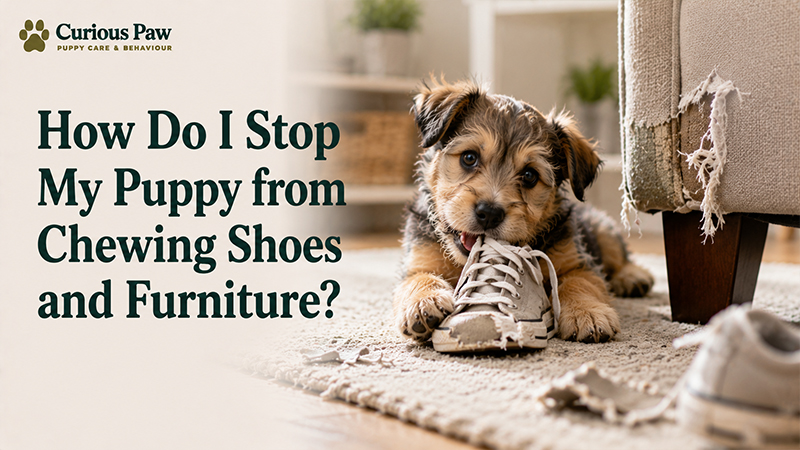
You walked into the room and found a shoe in three pieces. Or a groove chewed into a chair leg. Or the charging cable behind the sofa that apparently looked interesting at some point while nobody was watching. The puppy is sitting nearby looking approximately zero percent remorseful, because from their perspective they’ve done nothing wrong. Chewing is one of the most fundamentally normal puppy behaviors that exists — it’s not defiance, it’s not spite, and it can’t be trained away entirely. What can be managed is what gets chewed.
Why Puppies Chew Everything
Two things drive puppy chewing, and they overlap during the worst months. The first is teething — between roughly 12 weeks and 6 months, 28 baby teeth are being replaced by 42 adult teeth, and the process involves real gum discomfort. Chewing applies pressure to inflamed gum tissue in a way that provides relief, similar to why human infants chew on everything during teething. The second is exploration. Puppies investigate the world mouth-first. A shoe isn’t just interesting because of its texture — it carries the owner’s scent, which makes it one of the most compelling objects in the entire house from the puppy’s perspective.
Knowing this changes the response. Trying to stop the chewing entirely isn’t realistic. Redirecting it to appropriate targets and making inappropriate ones inaccessible is.
Management Is Not Optional
Every object a puppy chews that shouldn’t be chewed is a reinforced repetition of chewing that object. The puppy can’t learn that shoes are off-limits while continuing to chew shoes. The first intervention is removing access to everything the puppy shouldn’t have — shoes in closed closets, cords run through protective covers or tucked behind furniture, remote controls in drawers, loose clothing off the floor. Not because the puppy is bad, but because they can’t make a right choice when the wrong choice is the only available option.


Supervision is the other half of this. A puppy that’s directly supervised in a puppy-proofed space is a puppy that can be redirected before chewing becomes destruction. A puppy loose in an unsupervised house is a puppy that will find something to chew, and what they find might be dangerous as well as expensive. Until chewing is reliably redirected to appropriate objects, unsupervised access should be limited to the crate or a gated area where the contents are known and safe.
The Old Shoe Mistake
This one gets enough owners into trouble that it deserves its own section. Giving a puppy an old shoe to chew — a worn-out sneaker, a boot that’s past its useful life — seems like a reasonable solution. The puppy wants to chew shoes, here’s a shoe they can have. The problem is that the puppy cannot distinguish between the old shoe and every other shoe in the house. Leather smells like leather. Rubber soles smell like rubber soles. The scent and texture cue that says “this is an appropriate chew target” is the same across all shoes, old and new. An owner who gives a puppy an old shoe has taught the puppy that shoes are appropriate chew objects, and then expressed surprise when the puppy applies that lesson to the expensive ones.
The same logic applies to old socks, old gloves, or any human item being offered as a chew substitute. Everything that smells like a person and gets offered as a chew teaches “human items are chewable.” The alternatives need to be clearly distinct — rubber, nylon, rope, or food-based chews that don’t share sensory characteristics with household items.
What to Offer Instead
The puppy needs something to chew. The drive doesn’t go away by removing options — it finds whatever’s available. Providing three to five different types of appropriate chew at any given time gives the puppy genuine alternatives that compete with furniture and shoes for attention.
During teething, cold or frozen options help specifically because temperature reduces gum inflammation. A Kong stuffed and frozen, a frozen carrot, a wet rope toy frozen — these work better for teething discomfort than room-temperature chews and produce more sustained engagement. Rotating chews keeps them novel. The bully stick that’s been in the crate for two weeks is less interesting than a new one, and a puppy that’s lost interest in their chew objects is a puppy that starts investigating furniture again.
Bully sticks, rubber chew toys appropriate for teething (softer than adult-formulated options), and food-dispensing toys that reward chewing engagement all work well. The thumbnail test applies for toy hardness: press a thumbnail firmly into the material. If it leaves no mark, the toy is too hard for teething teeth. For puppies under six months, harder options can crack baby teeth or newly erupted adult teeth that haven’t fully hardened.
When You Catch Them In the Act
A calm interruption — “leave it” or a quiet sound — followed by immediate redirection to an appropriate chew is the correct response. Not a dramatic correction, not a chase around the room trying to retrieve the object, not anger that turns the whole episode into an exciting interaction. The puppy drops the shoe, gets the bully stick, gets praise for chewing the bully stick. The lesson being built: this thing produces nothing interesting, that other thing produces reward.
Finding destruction after the fact accomplishes nothing useful. The puppy made a connection between the chewing and the chewing reward minutes or hours ago. A reaction now teaches the puppy that the owner’s return sometimes produces something unpleasant — not that chewing the furniture was wrong. According to the ASPCA, corrections for found destruction are reliably ineffective and often create handling anxiety without changing the chewing behavior at all.
Bitter Apple and Deterrent Sprays
Bitter apple spray and similar deterrents work for some puppies and not others. Applied to furniture edges, baseboards, or specific objects the puppy targets, they make the surface aversive enough that the puppy stops investigating it. Testing on a small area first protects the surface and confirms the spray won’t cause damage. The effect wears off and requires reapplication. Some puppies habituate to it over time and start chewing the treated area again.
Deterrents manage the symptom without addressing the cause. A puppy with adequate appropriate chewing outlets and good supervision is less likely to investigate the coffee table leg in the first place. Using deterrents alongside proper chew provision and management produces better results than using them alone.
By seven to eight months, most puppies are through the peak teething phase and the frantic chewing of the early months becomes more manageable. The habits built during those months — what’s available to chew, what gets redirected, what the puppy has learned is theirs — determine whether the dog is safe to have loose in the house at a year. Getting the redirection right now is easier than addressing the consequences of not doing it.