
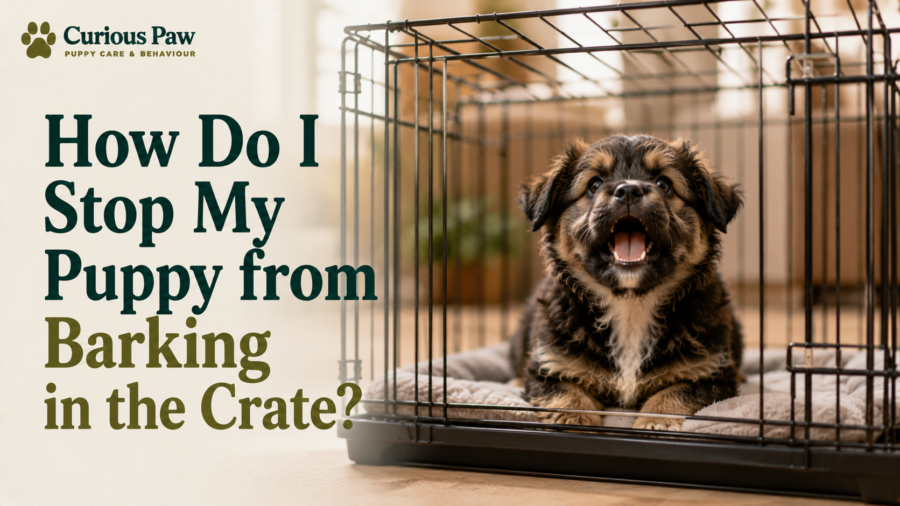
It’s 2am. The puppy has been barking in the crate for 20 minutes. You know that going in will teach them that barking opens the door. You also cannot listen to this for another 20 minutes. Every new owner who has been in this situation understands the specific paralysis of knowing what you’re supposed to do and finding it genuinely impossible to do it. The fix isn’t willpower. It’s understanding what the barking is actually about, and addressing that rather than trying to outlast it.
What the Barking Is Usually About
Crate barking in young puppies has a short list of causes, and identifying which one is happening changes everything about the response. The four most common: the puppy needs to go to the bathroom, the puppy is experiencing isolation distress, the introduction to the crate was too fast, or the duration has been extended beyond what the puppy can currently manage.
Bathroom urgency is the easiest to rule out: a puppy under 12 weeks can hold it for roughly two hours overnight, and a puppy under 10 weeks for even less. If it’s been two or more hours since the last bathroom trip, bladder pressure is likely involved and the trip is warranted. The response to this is a boring, functional trip outside — no lights, no talking, no engagement — and back in the crate. Not ignoring it.
Isolation distress — the specific anxiety of not being able to locate or access the attachment figure — is addressed through crate placement rather than through training. Moving the crate to the bedroom, where the puppy can smell and hear you, is the most effective single intervention for nighttime barking. A puppy that can confirm the pack is present through sensory access doesn’t experience the same distress as one sealed off in a separate room. The crate placement should happen before trying to manage the barking through any other means.
If the Introduction Was Too Fast
A puppy that was put in a crate for extended periods before any positive association was built has no reason to find the crate safe or comfortable. The barking in this situation isn’t a training problem to manage — it’s a communication that the foundation wasn’t laid correctly. Going back to the beginning of crate introduction, regardless of how far into the process you think you are, is the only effective path forward. Voluntary entry, feeding meals inside, very short door-closed periods with immediate reward, gradually extending duration. The process has to restart from where the positive association actually exists, not from where you wish it did.


A puppy that started barking immediately the first time the door closed has never had the opportunity to discover that the crate is a safe, comfortable space. The door closing is associated with distress from the very first experience. That association has to be replaced, and it can only be replaced through patient, incremental experience — not by weathering the barking.
How to Respond When Barking Happens
The rule that protects everything else: never open the crate door while the puppy is actively barking. Whatever the reason for the trip outside, wait for a pause — even a two-second breath between barks — before opening the door. Opening mid-bark teaches that barking opens the door, which is the lesson that makes crate barking worse over time. A brief pause before opening, even when the urgency is genuine, maintains the correct association.
This is harder than it sounds because the pause that needs to be caught is brief. A puppy that’s been barking steadily takes a breath between bursts — maybe two seconds, maybe less. That’s the moment. Most owners miss it because they’re waiting for the barking to stop entirely rather than watching for the first pause. The first pause is the opportunity. Reward it immediately, even before opening the door, with a calm “good” and a treat tossed through the bars. Then if a bathroom trip is needed, open calmly and proceed. The puppy learns that quiet produces access and that access doesn’t require sustained barking.
Daytime Barking in the Crate
Daytime crate barking — the puppy left for the morning while you work — has different likely causes than nighttime barking. A puppy that’s consistently barking during daytime crating is probably being crated for longer than their current bladder capacity and activity tolerance supports. According to the AKC, one hour per month of age is the rough guideline for daytime crating. A 10-week-old puppy being crated for four hours is going to bark — not out of stubbornness but because that duration is physiologically and emotionally unsupportable at that age.
Adequate physical and mental exercise before a crating period makes a real difference. A puppy that’s been walked, played with, trained briefly, and had a bathroom trip is in a genuinely different state to go into the crate than one that went directly from waking up to confinement. A frozen Kong or a long-lasting chew in the crate for the first 20 minutes bridges the awake-to-settled transition. Many puppies that bark continuously when put directly into an empty crate settle quickly when there’s something engaging to focus on first.
What You Don’t Know Without a Camera
A camera that connects to a phone is genuinely useful for crate barking because it reveals whether the puppy is genuinely distressed throughout the absence or whether they bark for 15 minutes, settle, and sleep for the remaining three hours. Many owners who live with the guilt of leaving a barking puppy discover through a camera that the puppy is fine most of the day — the barking was concentrated around departure and the perception of ongoing distress was inaccurate. Conversely, a puppy that’s genuinely distressed throughout the entire absence is showing a pattern that needs a different approach than management strategies can provide.
Frequently Asked Questions
Should I ignore my puppy barking in the crate at night?
It depends on what the barking is about. Brief whining that winds down on its own is worth waiting through. Sustained distress that isn’t settling after 10 to 15 minutes usually means the crate is too far from you, the introduction was rushed, or there’s genuine bladder urgency. Ignoring is the right response to brief vocalization that’s settling. It’s the wrong response to sustained distress that isn’t resolving. A camera helps tell the difference when you’re in another room.
My puppy stops barking the moment I come into the room — why?
The barking is functioning as a contact call — the puppy is vocalizing to locate you and confirm you’re accessible. When you appear, the call has been answered and the barking stops. This is different from anxiety-driven barking that continues even with you present. The response is moving the crate closer to where you are, ideally the bedroom, so the puppy can confirm your presence through smell and hearing without needing to vocalize to find you.
How long will the crate barking last?
For most puppies with a properly introduced crate placed in the bedroom, the worst of the barking phase is over within two to three weeks. By four to five months, most puppies settle in the crate reliably. Barking that continues well past this window, or that’s getting worse rather than gradually better, suggests either the introduction needs to restart or the duration being asked for exceeds what the puppy can currently manage.
The puppy that seemed impossible to settle in a crate at 9 weeks is often found sleeping in it voluntarily at 5 months — door open, no encouragement needed. The phase that feels permanent rarely is. What determines how long it lasts is mostly whether the setup and the responses are giving the puppy the right information or the wrong information each time it happens.
- PetMD — Puppy Crying in His Crate? Here’s What to Do
- American Kennel Club — How to Stop a Dog From Barking When Left Alone