
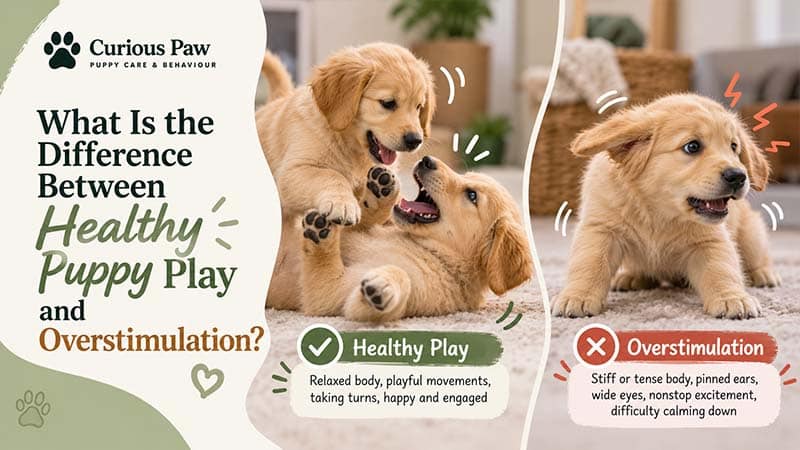
Healthy play and overstimulation can look deceptively similar to owners who are still learning to read their puppy’s behavioral state. Both involve energetic, intense physical activity, and both can include biting, vocalizing, and rapid movement. The difference is in the quality of the behavior, the puppy’s ability to self-regulate, and what happens when the interaction continues past the point where the puppy should have rested. Getting this distinction right matters because overstimulated puppies need rest, not more play, and continuing to engage when the puppy is already past threshold makes the biting harder and the behavior harder to shape.
Signs of Healthy Play
According to the ASPCA and AKC, a puppy in healthy play shows a loose, wiggly body, takes breaks voluntarily, responds to redirection without excessive difficulty, accepts the end of play without sustained protest, and recovers quickly from brief startles. Play bowing (front end lowered with rear up), role reversals in chase and wrestling, and exaggerated movements are all signs of play-state behavior. The puppy can be interrupted and resettles. Bite pressure during healthy play, while it can be intense for a puppy in the learning phase, is responsive to owner feedback: if the owner withdraws interaction after a hard bite, the puppy moderates rather than escalates.
Signs of Overstimulation
Overstimulation in puppies looks like a loss of the self-regulation that healthy play includes. A puppy past its threshold may bite harder than usual without responding to feedback, may struggle to settle when given the opportunity, may fixate on biting hands or ankles without being able to redirect to toys, and may show frantic rather than playful energy quality: eyes hard rather than soft, body tense rather than loose, activity driven rather than joyful. According to the ASPCA, many of the behavior problems owners report in the evening are actually overtiredness presenting as hyperactivity and bitiness, rather than excess energy that needs more exercise to address.
Preventing Overstimulation
Preventing overstimulation means ending play before the puppy reaches threshold rather than waiting for the behavioral deterioration that indicates threshold has been crossed. The practical approach is shorter, more frequent play sessions with enforced rest periods between them rather than one long session. Crate time following play is not punishment; it is the structured rest that allows the puppy to consolidate the arousal from the play session. A common guideline from veterinary behavior resources suggests roughly five minutes of structured activity per month of age per session as a starting point for very young puppies, extended gradually as the puppy matures. Mental stimulation and training count separately from physical exercise and often tire a puppy more effectively per unit of time.
What to Do When Overstimulation Happens
The effective response to an overstimulated puppy is not escalating correction or continued engagement but a calm, abrupt end to interaction. Remove the puppy to its crate or a quiet space, provide a chew toy, and allow the arousal to come down without further stimulation. Most overstimulated puppies settle within ten to fifteen minutes of this intervention. Engaging with an overstimulated puppy in an attempt to calm it through continued interaction almost always makes it worse; the removal of stimulation is what works.
Frequently Asked Questions
Is biting during play always a sign of overstimulation?
No. Mouthing and biting are normal components of puppy play at any arousal level. The distinction is whether the biting responds to feedback (the puppy moderates when the owner withdraws interaction) and whether bite pressure is proportionate to the play context. Hard, unresponsive biting that doesn’t change when interaction is withdrawn is overstimulation or frustration. Responsive mouthing that softens when play pauses is normal play behavior in the bite inhibition learning phase.
My puppy is worst in the evenings. Is this normal?
Yes, this is one of the most commonly reported patterns in young puppies and is normal. The evening “witching hour” of bitey, frantic behavior often reflects accumulated fatigue rather than energy that needs more outlets. A puppy that has had a full day of activity, socialization, and play often hits an arousal peak at the end of the day that looks like hyperactivity but is better addressed with enforced rest (crate, calm environment) than with more stimulation or exercise.
How do I build my puppy’s ability to self-regulate over time?
Self-regulation improves with both age and training. Teaching a specific settle or mat behavior from early puppyhood gives the puppy a practiced response to lowering arousal on cue. Consistent enforcement of rest periods after play (rather than allowing continuous arousal cycling) also builds better self-regulation over time. The neurological capacity for impulse control continues developing through the first year and beyond, so improvement is expected with maturation even without specific training, but training accelerates the process significantly.
